Umar ibn Al-Khattab: The Life and Legacy of Islam’s Second Caliph
From his early opposition to Islam to his leadership as the second caliph, Umar ibn Al-Khattab helped shape the early Muslim community. Discover his life, his approach to governance, the expansion of the Islamic state, and how Sunni Muslims remember his legacy.

Ahmed
Oct 21, 2026 • 8 min read
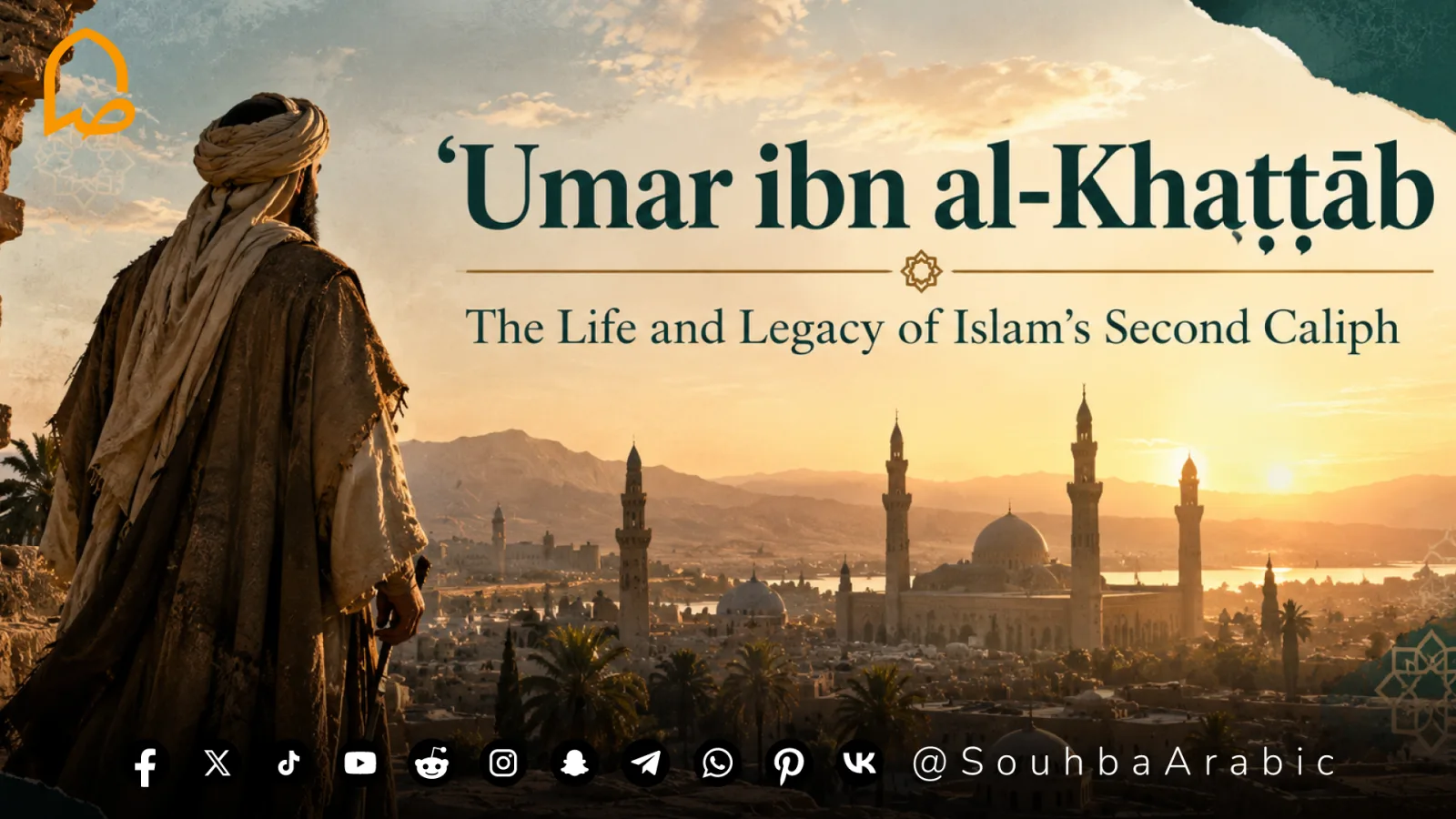
Umar ibn al-Khattab: The Man Behind the Legend
In 644 CE, Umar ibn al-Khattab (may Allah be pleased with him) was attacked while leading the dawn prayer in Medina. He died from his wounds several days later.
For ten years, he had led the Muslim community through a period of extraordinary change. Muslim rule had expanded into parts of the Byzantine and Persian empires, turning a small state in Arabia into a major regional power.
Yet one of the most revealing reports about Umar (RA) is not about a battle or a conquest. It describes him asking officials whether farmers in Iraq were being taxed too heavily—and expressing concern for widows who needed support.
That combination of power and responsibility helps explain why Umar (RA) remains one of the most respected figures in Sunni Islam.
But who was he before he became a leader, and how did he earn such a lasting place in Muslim history?
From Opponent to Companion
Umar (RA) was born in Mecca around 584–586 CE. He belonged to the Banu Adi clan of the Quraysh tribe, one of the leading tribes in the city.
In the early seventh century, the Prophet Muhammad (peace and blessings be upon him) began preaching Islam: belief in one God, responsibility for one's actions, and a life guided by faith. The new message challenged some of Mecca’s established religious and social traditions.
Umar (RA) initially opposed Islam. He later became Muslim and turned into one of the faith’s strongest supporters.
Popular Muslim stories describe his conversion as a dramatic turning point. The exact details are difficult to confirm, so it is better not to treat every scene in these stories as proven history. What stands out in the traditional account is the change in his role: a man remembered for opposing Islam became one of its leading figures.
His family also became closely connected to the Prophet Muhammad (peace and blessings be upon him). Umar’s daughter, Hafsa (may Allah be pleased with her), married the Prophet.
When the Prophet Muhammad (peace and blessings be upon him) died in 632 CE, the Muslim community faced a difficult question: who would lead it? Umar (RA) supported Abu Bakr (may Allah be pleased with him), who became the first caliph—the leader of the Muslim community after the Prophet. When Abu Bakr (RA) died in 634, Umar (RA) succeeded him.
He was now responsible for a community facing challenges far greater than those of its early years.
A Decade That Changed the Region
Umar (RA) ruled from 634 to 644 CE. During those ten years, Muslim armies expanded into Syria, Palestine, Iraq, and parts of the former Persian Empire. The conquest of Egypt also began during his rule.
These campaigns changed the political map of the Middle East. But the expansion was not the work of Umar (RA) alone. Military commanders, soldiers, local conditions, and the weakened state of the region’s great empires all played a role.
Conquest also did not mean that everyone in these territories immediately became Muslim. Religious change happened gradually, over generations.
For Umar (RA), expansion brought another challenge: how could a growing state govern people living in different lands, with different customs and religious traditions?
Military success was only part of the task. The new state also needed officials, systems for collecting taxes, and ways to manage public resources.
One of the clearest examples of Umar’s approach comes from a report preserved in Sahih al-Bukhari, an important collection of reports about the Prophet Muhammad (peace and blessings be upon him) and the early Muslim community, highly respected in Sunni Islam.
The Widows of Iraq
According to a report in Sahih al-Bukhari 3700, Umar (RA) questioned officials about taxes on farmland in Iraq. He wanted to know whether the taxes were heavier than the land could reasonably support.
He then expressed his hope that, if he lived, he would make it possible for widows in Iraq to live without needing support from men.
The detail is striking. Iraq was far from Medina, yet the report presents Umar (RA) thinking about the people affected by government decisions.
The report does not prove every popular story told about his justice, nor does it tell us exactly how every policy worked. But it offers a clear example of a concern that became central to his reputation: a leader should consider the people who bear the cost of his decisions.
For Sunni Muslims, this is an important part of Umar’s legacy. Leadership was not simply a position of honour. It brought responsibility—and, in his understanding of faith, accountability before Allah.
Jerusalem and the Story of the Camel
Jerusalem came under Muslim rule around 637–638 CE, during Umar’s (RA) time as caliph. The city is sacred to Christians and Jews, as well as to Muslims, and its change of rule formed part of a wider transformation in the region.
A well-known Muslim tradition tells of Umar (RA) travelling to Jerusalem with a servant and sharing one camel with him. According to the story, they took turns riding. When they reached the city, it was the servant’s turn, so Umar (RA) entered on foot.
The story has survived because it expresses an ideal of leadership: holding a position of power should not automatically make someone feel superior to others.
However, the exact details of the journey have not been firmly established. It is best understood as a story preserved in Muslim tradition, rather than an event whose every detail has been proven.
That does not make the story unimportant. It helps explain how later Muslims remembered Umar (RA): as a leader whose authority should come with humility, not luxury.
A Calendar Still Used Today
Another part of Umar’s (RA) legacy is connected to the Islamic calendar.
The calendar counts years from the Hijra, the migration of the Prophet Muhammad (peace and blessings be upon him) and his followers from Mecca to Medina in 622 CE. It follows the Moon, so its months move through the seasons over time.
Muslim historical tradition credits Umar’s (RA) government with making the Hijra the starting point for official dates and records. Historians note that early dating practices developed over time, so the process was more complex than creating a complete system in a single moment.
The calendar remains important to Muslims today. It marks Ramadan, the Hajj pilgrimage to Mecca, and the two Eid celebrations, connecting daily life with key events in Islamic history.
His Final Days
In 644 CE, Umar (RA) was stabbed while leading the dawn prayer in Medina. He died several days later.
A report in Sahih al-Bukhari describes Abdullah ibn Abbas (may Allah be pleased with him) visiting Umar (RA) after the attack. The account portrays Umar (RA) as worried about the judgment he would face before Allah.
This concern is central to how Sunni Muslims remember him. Even as a powerful ruler, he believed he would have to answer for his actions.
Before his death, Umar (RA) arranged for a council of six leading Companions of the Prophet Muhammad (peace and blessings be upon him) to choose the next caliph. Their discussions led to the selection of Uthman ibn Affan (may Allah be pleased with him).
The decision helped the community choose a new leader, although questions about political power and succession would continue to shape Muslim history.
Why Umar Is Still Remembered
In Sunni Islam, Umar (RA) is honoured as the second of the four Rightly Guided Caliphs—the first four leaders who followed the Prophet Muhammad (peace and blessings be upon him).
He is also traditionally associated with the title Al-Faruq, commonly understood as “the one who distinguishes between truth and falsehood.”
His reputation rests on several qualities: courage, commitment to Islam, firm leadership, personal simplicity, and concern for justice.
Historical accounts do not all have the same level of certainty. The main events of his life are widely recognised, while some famous speeches and dramatic stories are harder to verify. Respecting Umar’s (RA) place in Sunni belief does not require presenting every popular story as established fact.
His life remains important because it brings together faith, political change, and the difficult responsibilities of leadership. His rule helped shape the early Muslim state, while stories about his character continue to influence how many Muslims think about justice and public duty.
Perhaps that is why his story reaches beyond dates and conquests. It raises a question that still matters today:
If leadership gives someone power over others, what responsibility comes with it?
For Sunni Muslims, Umar’s (RA) legacy offers one answer: power should be used fairly, and those who hold it must remain accountable before Allah.
Explore Arabic and Islamic Culture with Souhba
Learning Arabic is more than memorising words. It can open a door to the history, ideas, and traditions of the people who speak it.
At Souhba, we offer guided learning in Modern Standard Arabic, Egyptian Arabic, Arabic for children, and Quran reading with Tajweed—the rules for reciting the Quran correctly.
Whether you are just starting or want to understand Arabic more deeply, contact Souhba to explore your learning options.
Sources and Further Reading
-
Sahih al-Bukhari 3700 — A report about Umar (RA) questioning officials about land taxes in Iraq and expressing concern for widows.
https://sunnah.com/bukhari:3700 -
Sahih al-Bukhari 3692 — A report about Umar (RA) after he was wounded and his concern about answering to Allah for his actions.
https://sunnah.com/bukhari:3692 -
Encyclopaedia Britannica — “Umar I” — An overview of his life, rule, and historical importance.
https://www.britannica.com/biography/Umar-I -
Encyclopaedia Iranica — “Calendars in the Islamic Period” — Background on the development of the Islamic calendar.
https://www.iranicaonline.org/articles/calendars/calendars-ii-in-the-islamic-period/ -
Cambridge History of Egypt — “Egypt as a Province in the Islamic Caliphate, 641–868” — Historical background on the conquest and administration of Egypt.
https://www.cambridge.org/core/books/abs/cambridge-history-of-egypt/egypt-as-a-province-in-the-islamic-caliphate-641868/FF5C416D97BB2C72F30F2E435B6AD7F4
Master the Arabic Language
Learn Egyptian Arabic, MSA, or Quran & Tajweed 1-on-1 with patient native tutors.
Free 30-minute trial · no card needed