Understanding the Differences Between Quranic and Modern Standard Arabic
Quranic Arabic and Modern Standard Arabic are closely related, but they are not simply the same thing. Learn what connects them and why the distinction matters for learners.

Ahmed
Sep 10, 2026 • 4 min read
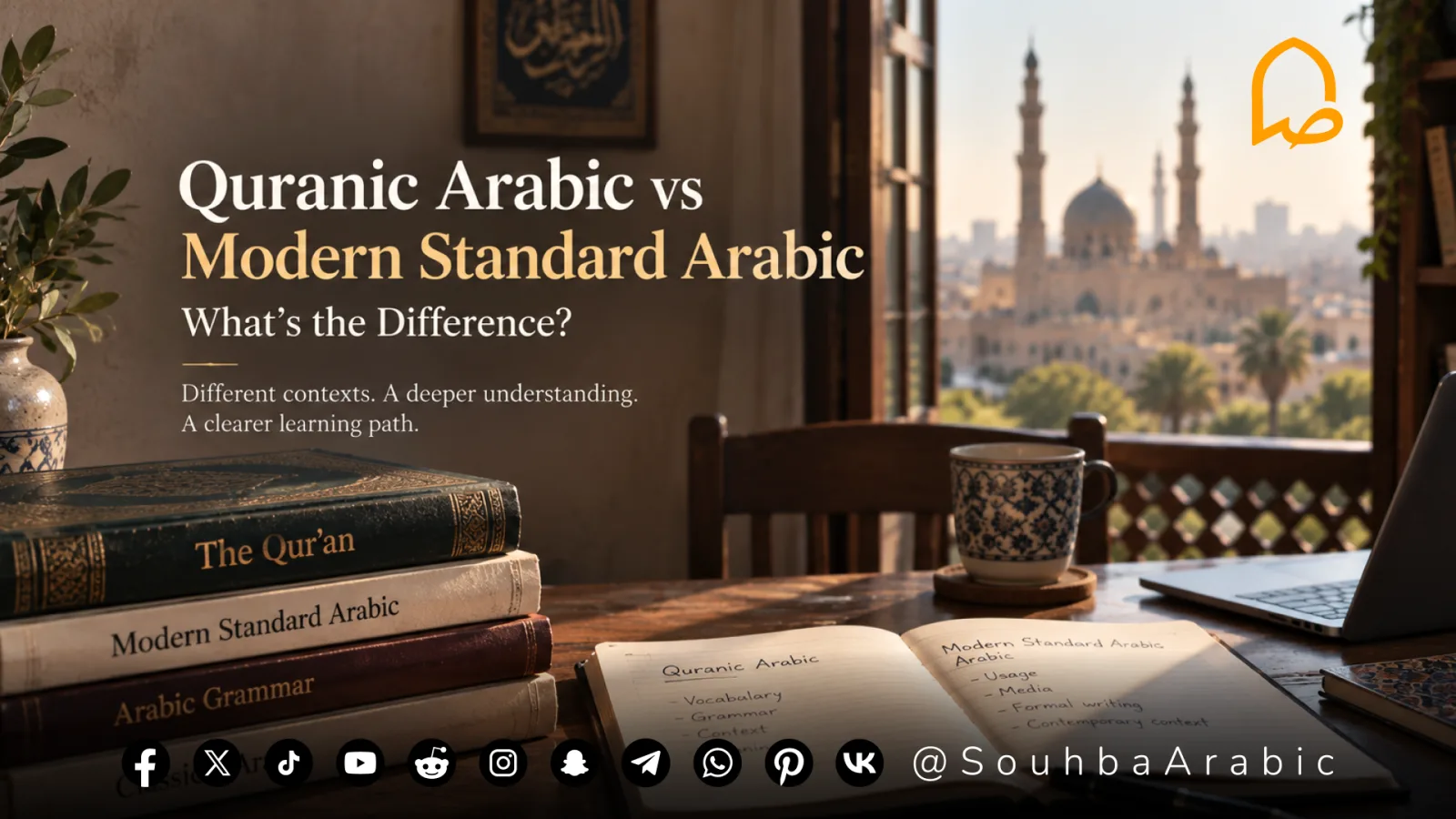
Quranic Arabic vs Modern Standard Arabic: What's the Difference?
If you're learning Arabic because you want to understand the Quran, you may eventually come across another question:
"Is Quranic Arabic the same as Modern Standard Arabic?"
The short answer is no.
They are closely related, and studying Modern Standard Arabic can give you useful foundations. But Quranic Arabic belongs to an earlier form of Arabic and has linguistic features that deserve focused study.
Understanding this distinction can help you choose a learning path that actually matches your goal.
What is Quranic Arabic?
The Quran was revealed in Arabic and its language belongs to the Arabic of the Quran's historical period.
When people say "Quranic Arabic," they generally mean the language of the Quran and the vocabulary, grammar, structures, and linguistic features involved in understanding its text.
For someone learning Arabic in order to understand the Quran, the goal is not simply to recognize Arabic letters or memorize translations.
It is to gradually develop the ability to understand the Arabic of the Quran itself.
What is Modern Standard Arabic?
Modern Standard Arabic, commonly shortened to MSA, is the standardized form of Arabic widely used today in formal writing and many formal contexts.
You'll encounter it in areas such as:
- News
- Books
- Formal articles
- Education
- Official communication
- Formal speeches
MSA is closely connected to Classical Arabic and shares much of its grammatical and lexical foundation.
But it is not simply identical to the Arabic of the Quran.
So what do they have in common?
Quite a lot.
A learner studying MSA will encounter Arabic vocabulary, grammatical structures, and patterns that can also be relevant when studying Quranic Arabic.
This is one reason MSA can provide useful foundations.
For example, becoming familiar with Arabic grammar, verb patterns, word formation, and vocabulary can make later study of Quranic texts more approachable.
But that does not mean the learner can automatically pick up a Quran and understand everything.
Does learning MSA mean you understand the Quran?
No.
This is one of the most important points for beginners.
A person may be able to read MSA articles, understand formal Arabic sentences, and still struggle with Quranic vocabulary, grammar, rhetorical structures, or unfamiliar expressions.
The opposite is also worth remembering: someone who has studied Quranic Arabic for a particular purpose does not necessarily have the same ability to communicate naturally in an Egyptian conversation.
Different goals require different kinds of Arabic learning.
What about Egyptian Arabic?
This is where things can become confusing.
You may hear three terms:
| Term | Description |
|---|---|
| Quranic/Classical Arabic | the language of the Quran and the earlier Arabic tradition |
| Modern Standard Arabic | the standardized formal Arabic used widely today |
| Egyptian Arabic | the spoken variety commonly used in everyday life in Egypt |
They are related, but they serve different purposes.
Imagine someone wants to:
| Goal | Focus |
|---|---|
| Understand the Quran | Quranic Arabic should be central to the learning path. |
| Read Arabic news and formal writing | MSA is particularly relevant. |
| Have everyday conversations in Egypt | Egyptian Arabic is the practical focus. |
Some learners eventually study more than one.
Which should you learn?
Start with your reason for learning Arabic.
If your main goal is Quran study, don't feel that you need to become an advanced MSA speaker before you can begin learning Quranic Arabic.
You can build useful Arabic foundations while studying vocabulary and structures that occur in the Quran.
If your goal is communication in Egypt, Egyptian Arabic may deserve much more attention.
If your goal is formal reading and writing, MSA may be the better starting point.
There isn't a single "correct" Arabic path for everyone.
The important thing is to know what you're studying
One of the biggest sources of frustration for Arabic learners is assuming that every form of Arabic should work the same way.
It doesn't.
Arabic has different varieties and historical forms, and learners benefit from knowing which one they're studying and why.
Once that becomes clear, the language often feels less confusing.
Instead of asking:
"Which Arabic should everyone learn?"
A better question is:
"Which Arabic will help me achieve my goal?"
For Quran study, that means giving Quranic Arabic the attention it deserves.
Master the Arabic Language
Learn Egyptian Arabic, MSA, or Quran & Tajweed 1-on-1 with patient native tutors.
Free 30-minute trial · no card needed