5 Essential Arabic Connectors for Beginners in MSA
Learn five essential MSA Arabic connectors—وَ, لِأَنَّ, لِذَلِكَ, لَكِنْ, and ثُمَّ—with practical examples, clear grammar tips, and a short self-test.

Ahmed
Oct 12, 2026 • 4 min read
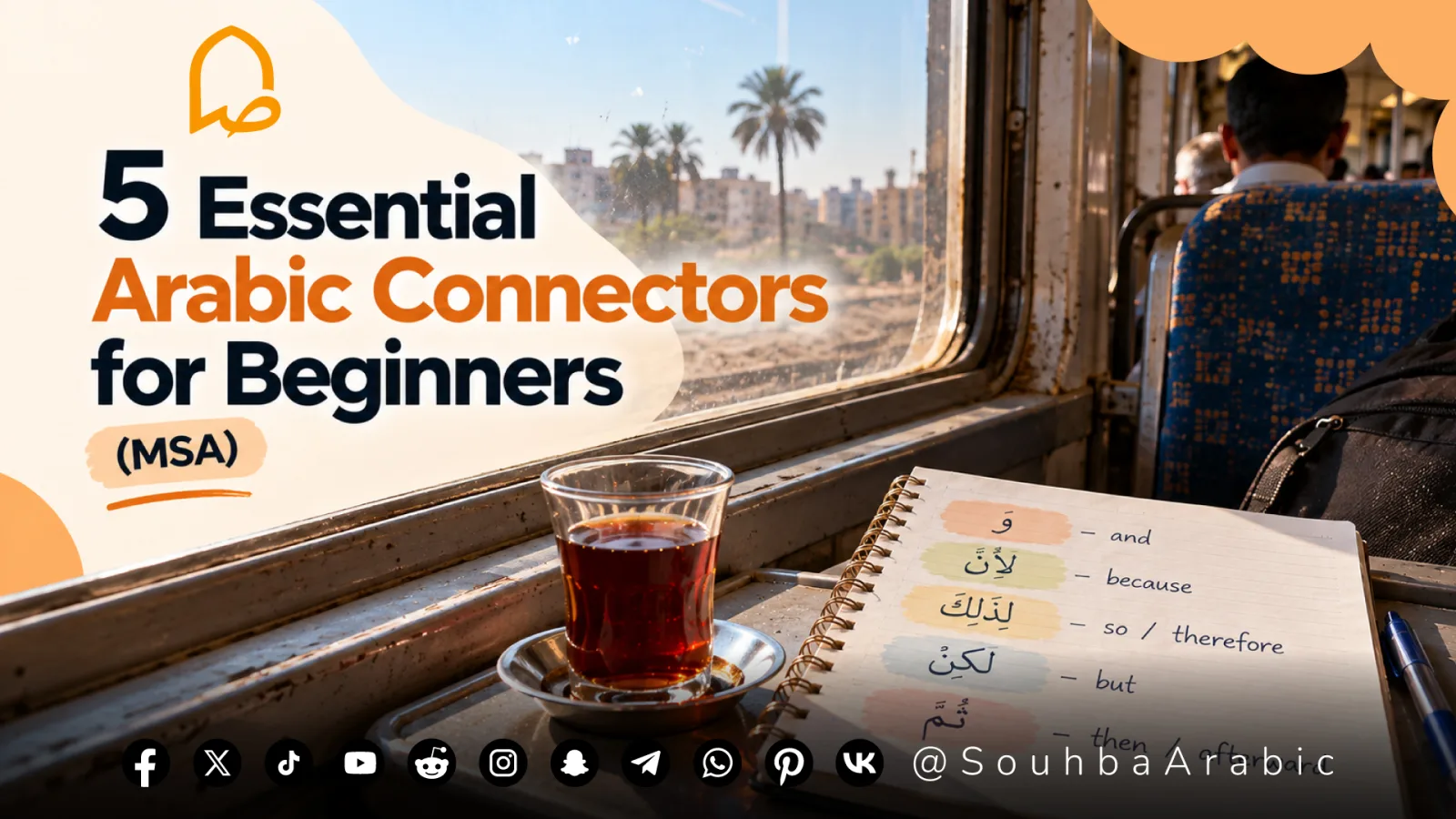
5 Essential Arabic Connectors for Beginners (MSA)
You know how to say simple things in Arabic, but your sentences still sound disconnected:
“I study Arabic. I want to read the Qur’an. I practise every day.”
The problem isn't necessarily your vocabulary. You need a few words that help you connect your ideas.
In Modern Standard Arabic (MSA), five useful connectors can help you add information, explain reasons, show results, express contrast, and describe what happens next.
Let's learn them through everyday examples you can actually use.
Quick Overview of the 5 Connectors
| Arabic | Transliteration | Meaning | Function |
|---|---|---|---|
| وَ | wa | and | adds information |
| لِأَنَّ | liʾanna | because | explains reason |
| لِذَلِكَ | li-dhālika | so / therefore | shows result |
| لَكِنْ / لَكِنَّ | lākin / lākinna | but / however | expresses contrast |
| ثُمَّ | thumma | then / afterward | describes sequence |
1. وَ — And
وَ (wa) connects words, phrases, or sentences. It's one of the most useful connectors to learn first.
Examples
| Arabic | Transliteration | English |
|---|---|---|
| أَدْرُسُ الْعَرَبِيَّةَ وَأَقْرَأُ كُتُبًا مُفِيدَةً. | Adrusu al-ʿarabiyyata wa-aqraʾu kutuban mufīdatan. | I study Arabic and read useful books. |
| أُرِيدُ قَهْوَةً وَمَاءً، مِنْ فَضْلِكَ. | Urīdu qahwatan wa-māʾan, min faḍlik. | I'd like coffee and water, please. |
Teacher's tip: In Arabic writing, وَ attaches directly to the following word. Write وَالْمَاءُ, not وَ الْمَاءُ.
Use وَ whenever you want to combine related information without making separate sentences.
2. لِأَنَّ — Because
Use لِأَنَّ (liʾanna) to explain why something happens. Think of it as your answer to لِمَاذَا؟ (limādhā?) — “Why?”
Examples
| Arabic | Transliteration | English |
|---|---|---|
| أَتَعَلَّمُ الْعَرَبِيَّةَ لِأَنِّي أُرِيدُ أَنْ أَفْهَمَ الْقُرْآنَ. | Ataʿallamu al-ʿarabiyyata liʾannī urīdu an afhama al-Qurʾān. | I'm learning Arabic because I want to understand the Qur'an. |
| لَمْ أَخْرُجْ لِأَنَّ الْجَوَّ مُمْطِرٌ. | Lam akhruj liʾanna al-jawwa mumṭirun. | I didn't go out because it's raining. |
Notice two common forms:
| Arabic | Meaning |
|---|---|
| لِأَنِّي | because I … |
| لِأَنَّهُ | because he / it … |
The form changes depending on the pronoun or noun that follows. For example, لِأَنَّهَا means “because she / it …”
Teacher's tip: Learn لِأَنِّي as a complete phrase first. You can use it to explain your own choices, preferences, and goals.
3. لِذَلِكَ — So / Therefore
While لِأَنَّ introduces a reason, لِذَلِكَ (li-dhālika) introduces a result. It means “so,” “therefore,” or “for that reason.”
Examples
| Arabic | Transliteration | English |
|---|---|---|
| عِنْدِي امْتِحَانٌ غَدًا، لِذَلِكَ أَدْرُسُ اللَّيْلَةَ. | ʿIndī imtiḥānun ghadan, li-dhālika adrusu al-laylah. | I have an exam tomorrow, so I'm studying tonight. |
| أُرِيدُ أَنْ أَتَحَدَّثَ بِطَلَاقَةٍ، لِذَلِكَ أَتَدَرَّبُ كُلَّ يَوْمٍ. | Urīdu an ataḥaddatha bi-ṭalāqatin, li-dhālika atadarrabu kulla yawmin. | I want to speak fluently, so I practise every day. |
The difference between the two
Compare these sentences:
| Arabic | English | Focus |
|---|---|---|
| أَدْرُسُ لِأَنَّ عِنْدِي امْتِحَانًا. | I study because I have an exam. | Explains the reason |
| عِنْدِي امْتِحَانٌ، لِذَلِكَ أَدْرُسُ. | I have an exam, so I study. | Introduces the result |
Teacher's tip: When you're unsure which connector to use, ask yourself: “Am I explaining why, or am I introducing what follows as a result?”
4. لَكِنْ / لَكِنَّ — But / However
Use these forms to introduce a contrast between ideas. Both can be translated as “but,” but they work differently in Arabic grammar.
Examples
| Arabic | Transliteration | English |
|---|---|---|
| أُحِبُّ الْقَهْوَةَ، لَكِنْ لَا أَشْرَبُهَا فِي الْمَسَاءِ. | Uḥibbu al-qahwata, lākin lā ashrabuhā fī al-masāʾ. | I like coffee, but I don't drink it in the evening. |
| الْكِتَابُ مُفِيدٌ، لَكِنَّهُ صَعْبٌ قَلِيلًا. | Al-kitābu mufīdun, lākinnahu ṣaʿbun qalīlan. | The book is useful, but it's a little difficult. |
What is the difference?
| Form | Function | Example |
|---|---|---|
| لَكِنْ | connects a contrasting clause | لَكِنْ لَا أَشْرَبُهَا — “but I don't drink it.” |
| لَكِنَّ | introduces a contrasting nominal clause | لَكِنَّهُ صَعْبٌ — “but it is difficult.” |
You don't need to master the full grammar immediately. Start by learning both examples as complete sentences, and notice which form appears in each.
5. ثُمَّ — Then / Afterward
Use ثُمَّ (thumma) to describe actions in sequence. It is particularly useful when telling a story, explaining a routine, or describing steps.
Examples
| Arabic | Transliteration | English |
|---|---|---|
| أَتَنَاوَلُ الْفَطُورَ، ثُمَّ أَذْهَبُ إِلَى الْعَمَلِ. | Atanāwalu al-fuṭūra, thumma adhhabu ilā al-ʿamal. | I eat breakfast, then go to work. |
| قَرَأْتُ الدَّرْسَ، ثُمَّ كَتَبْتُ الْوَاجِبَ. | Qaraʾtu al-darsa, thumma katabtu al-wājib. | I read the lesson, then wrote the assignment. |
Teacher's tip: Arabic also uses فَـ (fa) to connect events. Both فَـ and ثُمَّ can indicate sequence, but فَـ often emphasizes a closer connection or immediate consequence, while ثُمَّ commonly presents a subsequent step.
For now, practise ثُمَّ with your daily routine. It's an easy way to turn a list of actions into a connected description.
Practice: Choose the Correct Connector
Choose the best answer for each sentence. Try all five before checking the answer key.
| # | English | Arabic Sentence | Options | Answer |
|---|---|---|---|---|
| 1 | I'm tired, so I'll rest a little. | أَنَا مُتْعَبٌ، ______ سَأَسْتَرِيحُ قَلِيلًا. | A. لِذَلِكَ B. لَكِنْ C. ثُمَّ |
A |
| 2 | I'm learning Arabic because I love the language. | أَتَعَلَّمُ الْعَرَبِيَّةَ ______ أُحِبُّ هَذِهِ اللُّغَةَ. | A. لِذَلِكَ B. لِأَنِّي C. ثُمَّ |
B |
| 3 | I like tea and coffee. | أُحِبُّ الشَّايَ ______ الْقَهْوَةَ. | A. وَ B. لِأَنَّ C. لَكِنْ |
A |
| 4 | The lesson is difficult, but it's very useful. | الدَّرْسُ صَعْبٌ، ______ مُفِيدٌ جِدًّا. | A. لِذَلِكَ B. لَكِنَّهُ C. ثُمَّ |
B |
| 5 | I finished work, then I went home. | اِنْتَهَيْتُ مِنَ الْعَمَلِ، ______ ذَهَبْتُ إِلَى الْبَيْتِ. | A. لِأَنَّ B. وَ C. ثُمَّ |
C |
Answer key
- A — لِذَلِكَ introduces the result.
- B — لِأَنِّي introduces the reason.
- A — وَ connects two items.
- B — لَكِنَّهُ introduces the contrast: “but it is …”
- C — ثُمَّ describes the next action.
Make These Connectors Part of Your Arabic
Don't memorize the five words in isolation. Use them to describe things you genuinely want to say.
Try answering these questions in Arabic:
- What are two things you enjoy? Connect them with وَ.
- Why are you learning Arabic? Explain with لِأَنِّي.
- What do you want to improve, and what will you do about it? Use لِذَلِكَ.
- What do you like but rarely do? Practise لَكِنْ.
- What do you do after breakfast? Use ثُمَّ.
Start with short sentences. Once you can use a connector comfortably, try combining two ideas into a longer sentence.
The goal isn't to sound academic. It's to express simple thoughts clearly and confidently.
Learn Modern Standard Arabic with Souhba
At Souhba, we help learners build Arabic step by step through personalized one-to-one lessons, practical examples, and patient guidance.
If you're ready to move beyond isolated words and practise expressing your own ideas, book a free introductory session and discover an approach suited to your level.
Master the Arabic Language
Learn Egyptian Arabic, MSA, or Quran & Tajweed 1-on-1 with patient native tutors.
Free 30-minute trial · no card needed