Masculine and Feminine in Arabic: A Beginner’s Guide
Learn how masculine and feminine work in Modern Standard Arabic (MSA). Discover the feminine ending ة, adjective agreement, هَذَا vs. هَذِهِ, and common beginner mistakes.

Nady
Oct 11, 2026 • 5 min read
Masculine and Feminine in Arabic: A Beginner’s Guide
If you are learning Modern Standard Arabic (MSA), you will quickly notice something different from English.
In English, the word “this” stays exactly the same whether you are talking about a book or a car.
In Arabic, it changes:
| Arabic | Transliteration | English |
|---|---|---|
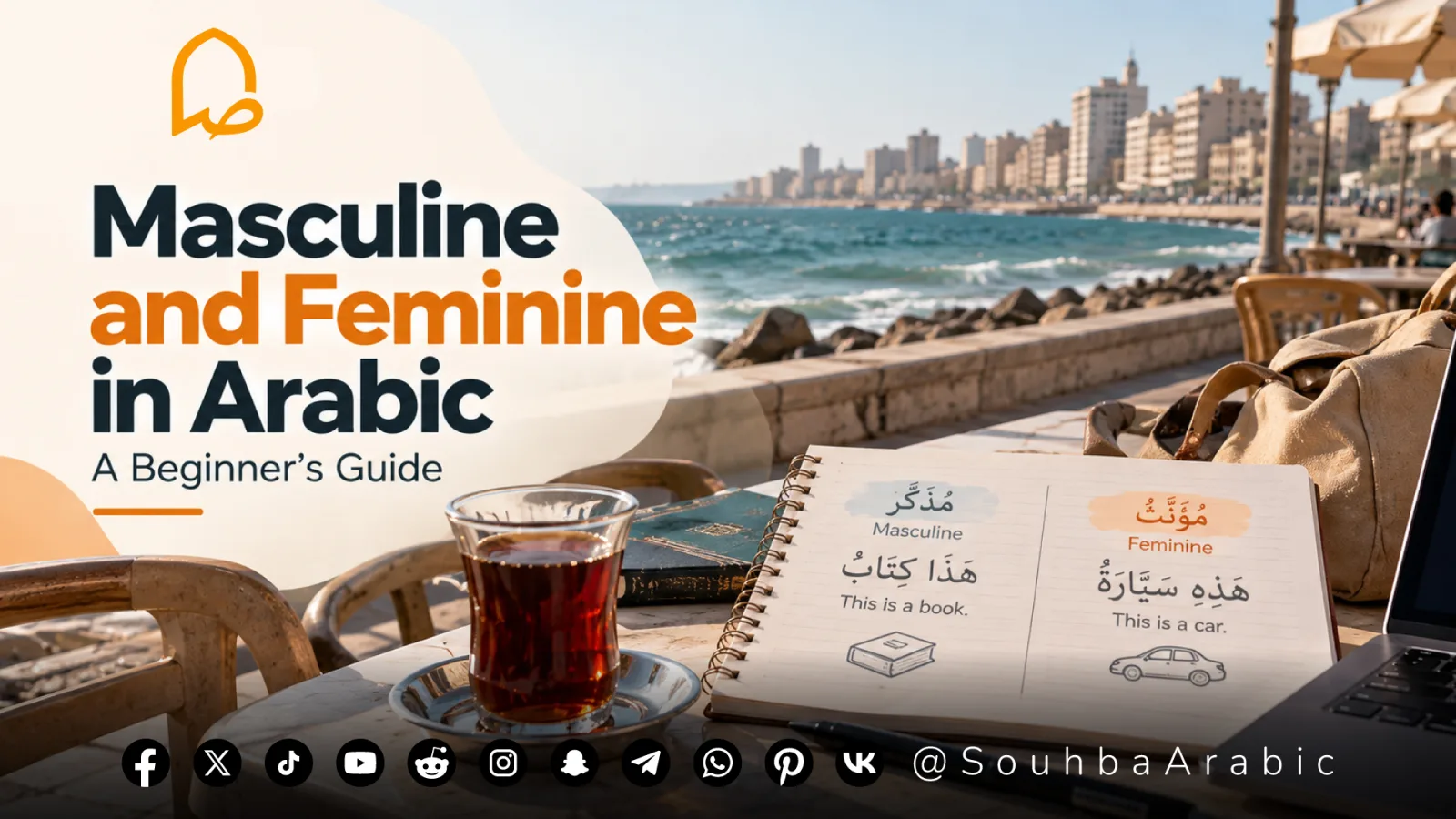
| هَذَا كِتَابٌ | hādhā kitābun | This is a book. |
| هَذِهِ سَيَّارَةٌ | hādhihi sayyāratun | This is a car. |
Why? Because Arabic uses grammatical gender. Every noun is treated as either masculine or feminine, even everyday objects that have no biological sex.
The good news is that you do not need to memorize dozens of complicated rules on your first day. Start by learning the most common feminine ending, seeing how adjectives change, and practicing with real, simple sentences.
Here is what you actually need to know to get started.
1. What Does Masculine and Feminine Mean in Arabic?
The Arabic terms are:
| Arabic | Transliteration | Meaning |
|---|---|---|
| مُذَكَّر | mudhakkar | masculine |
| مُؤَنَّث | muʾannath | feminine |
When talking about people, grammatical gender usually matches whether the person is male or female:
| Masculine | Feminine | Meaning |
|---|---|---|
| طَالِبٌ | طَالِبَةٌ | male / female student |
| مُعَلِّمٌ | مُعَلِّمَةٌ | male / female teacher |
| مُهَنْدِسٌ | مُهَنْدِسَةٌ | male / female engineer |
| مُدِيرٌ | مُدِيرَةٌ | male / female director |
But grammatical gender also applies to objects, places, and ideas. For example:
| Arabic | Transliteration | Gender |
|---|---|---|
| كِتَابٌ | kitābun | masculine |
| بَابٌ | bābun | masculine |
| سَيَّارَةٌ | sayyāratun | feminine |
| مَدْرَسَةٌ | madrasatun | feminine |
A car is not biologically female, of course. Its gender is simply a part of how Arabic grammar works.
2. The Most Useful Clue: The Letter ة (Taa Marbouta)
One of the easiest ways to recognize a feminine word is to look for the letter ة, called tāʾ marbūṭa.
It sits at the end of many feminine nouns:
| Masculine | Feminine | Meaning |
|---|---|---|
| طَالِب | طَالِبَة | student |
| مُعَلِّم | مُعَلِّمَة | teacher |
| كَبِير | كَبِيرَة | big |
| جَدِيد | جَدِيدَة | new |
Notice that this same ending appears when you change a masculine word for a person into its feminine counterpart, or when you change an adjective to describe a feminine noun.
However, treat ة as a very helpful clue, not a perfect rule. Some feminine nouns do not end in ة (like شَمْسٌ – sun, or يَدٌ – hand), and a few masculine names do (like حَمْزَةُ – Hamza).
Practical advice: Use the ending to make an educated guess, but try to learn the gender naturally along with each new noun.
3. Adjectives Must Match the Noun
This is where grammatical gender becomes important for everyday conversation. In MSA, words that describe things (adjectives) have to match the gender of the noun.
Compare these two phrases:
| Arabic | Transliteration | English |
|---|---|---|
| مَنْزِلٌ كَبِيرٌ | manzilun kabīrun | A big house. |
| غُرْفَةٌ كَبِيرَةٌ | ghurfatun kabīratun | A big room. |
The word for “big” changes from كَبِيرٌ to كَبِيرَةٌ because a house is masculine and a room is feminine.
Here are a few more everyday examples:
| Masculine phrase | Feminine phrase | Meaning |
|---|---|---|
| طَالِبٌ جَدِيدٌ | طَالِبَةٌ جَدِيدَةٌ | a new student |
| بَابٌ مَفْتُوحٌ | نَافِذَةٌ مَفْتُوحَةٌ | an open door / window |
| كِتَابٌ مُفِيدٌ | مَعْلُومَةٌ مُفِيدَةٌ | a useful book / piece of information |
4. “This” Also Changes: هَذَا vs. هَذِهِ
English uses the word “this” for everything. Arabic distinguishes between them.
| Demonstrative | Used with | Example | Transliteration | English |
|---|---|---|---|---|
| هَذَا | masculine noun | هَذَا كِتَابٌ جَدِيدٌ. | Hādhā kitābun jadīdun. | This is a new book. |
| هَذِهِ | feminine noun | هَذِهِ سَيَّارَةٌ جَدِيدَةٌ. | Hādhihi sayyāratun jadīdatun. | This is a new car. |
Notice the beautiful pattern here: you are not just changing one word. You are making all the parts of the sentence—the demonstrative, the noun, and the adjective—agree with each other.
5. What About Verbs?
Gender also affects verbs in Arabic, especially when you are talking about someone in the past or present tense.
Compare these two sentences:
| Arabic | Transliteration | English |
|---|---|---|
| الطَّالِبُ دَرَسَ. | Aṭ-ṭālibu darasa. | The male student studied. |
| الطَّالِبَةُ دَرَسَتْ. | Aṭ-ṭālibatu darasat. | The female student studied. |
In the past tense, the verb changes from دَرَسَ to دَرَسَتْ to agree with the feminine subject. You do not need to memorize every verb chart immediately. First, become comfortable matching nouns with adjectives, and then gradually practice verb agreement as you learn new vocabulary.
6. Five Common Mistakes to Avoid
When you are just starting out, don't worry about being perfect. But keep an eye out for these common beginner traps:
| # | Mistake | Correction / Note |
|---|---|---|
| 1 | Assuming every noun ending in ة is a female person. | A مَدْرَسَةٌ is a school, not a woman. The ending signals grammatical gender, not biological sex. |
| 2 | Forgetting to change the adjective. | Saying سَيَّارَةٌ جَدِيدٌ is incorrect. It should be سَيَّارَةٌ جَدِيدَةٌ (a new car). |
| 3 | Using هَذَا for every object. | Say هَذَا بَابٌ (“This is a door”) but هَذِهِ نَافِذَةٌ (“This is a window”). |
| 4 | Guessing gender based on English. | English does not tell you if an Arabic noun is masculine or feminine. Learn the Arabic word and its gender together. |
| 5 | Expecting every word to follow the exact same pattern. | Adding ة works for many adjectives, but there are exceptions (for example, colors). Learn the common pattern first, and pick up the exceptions as you go. |
7. Practice: Can You Choose the Correct Form?
Try completing each sentence before checking the answers at the bottom.
1. This is a new book.هَذَا كِتَابٌ ______.
- A. جَدِيدٌ
- B. جَدِيدَةٌ
2. This is a big car.هَذِهِ سَيَّارَةٌ ______.
- A. كَبِيرٌ
- B. كَبِيرَةٌ
3. The female student studied.الطَّالِبَةُ ______.
- A. دَرَسَ
- B. دَرَسَتْ
4. This is a new school.______ مَدْرَسَةٌ جَدِيدَةٌ.
- A. هَذَا
- B. هَذِهِ
(Answers: 1 — A; 2 — B; 3 — B; 4 — B)
A Simple Way to Remember Arabic Gender
When you learn a new MSA noun, do not memorize it as an isolated word on a flashcard. Learn it inside a short, real sentence that shows its gender.
Instead of just memorizing سَيَّارَةٌ (car), memorize:
هَذِهِ سَيَّارَةٌ جَدِيدَةٌ.(This is a new car.)
That one short sentence naturally teaches you the noun, its gender, the correct demonstrative, and the matching adjective.
You do not need to master every exception before you start speaking or reading. Build the habit of noticing gender in real sentences, and the patterns will become second nature over time.
Learn Modern Standard Arabic with Souhba
You shouldn't have to figure out Arabic grammar alone. At Souhba, we help learners build their Arabic step by step, replacing confusing terminology with clear explanations and practical examples. If you want to learn to read, write, and speak confidently with a patient, 1-on-1 teacher, book a free introductory session to see how we teach.
Master the Arabic Language
Learn Egyptian Arabic, MSA, or Quran & Tajweed 1-on-1 with patient native tutors.
Free 30-minute trial · no card needed