Modern Standard Arabic vs Egyptian Arabic: What's the Difference?
Modern Standard Arabic and Egyptian Arabic are both important, but they serve different purposes. Learn where each is used, how they differ, and which one makes sense for conversation, travel, work, reading, or religious study.

Nady
Sep 4, 2026 • 3 min read
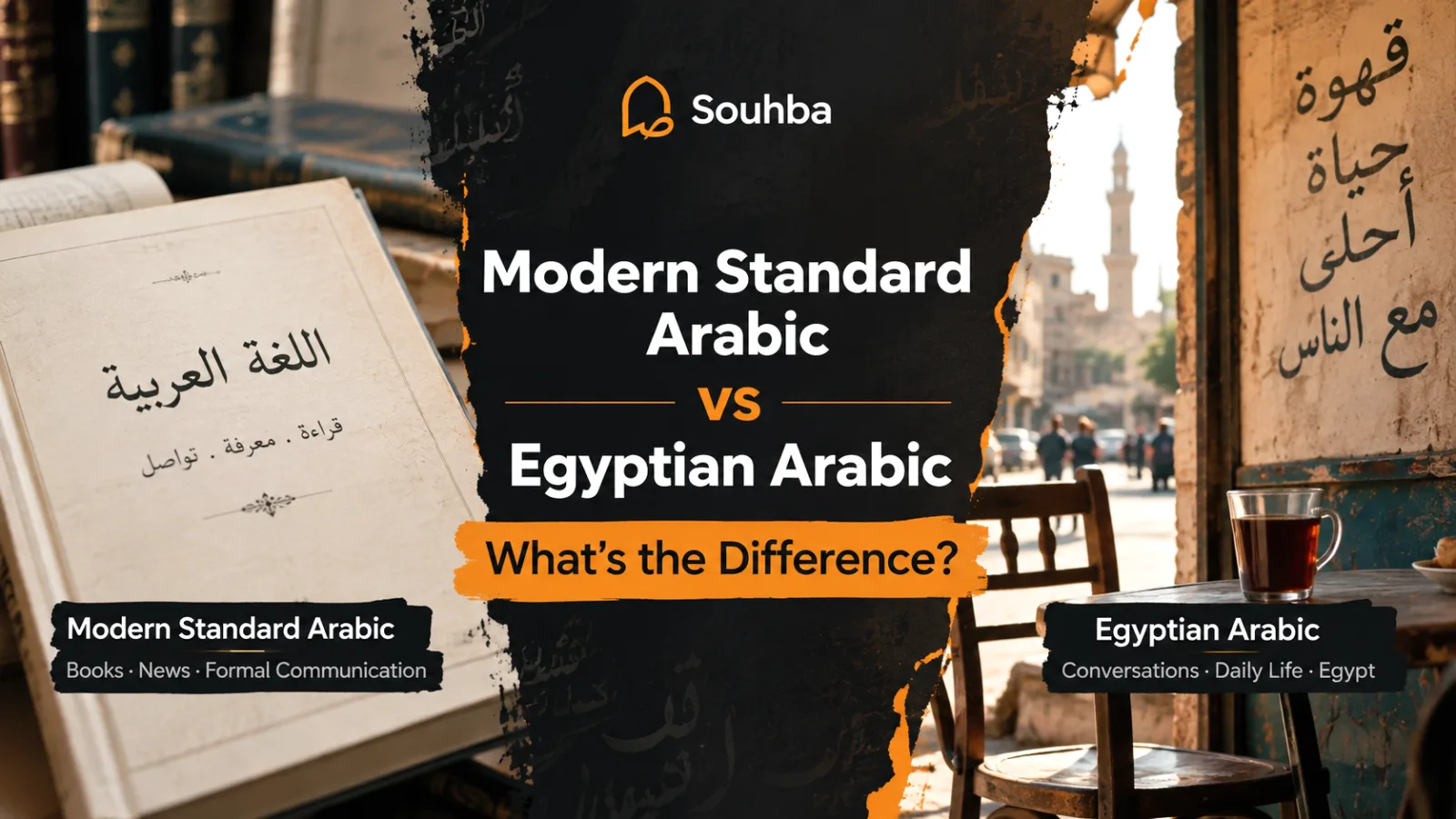
If you're learning Arabic, you may have noticed that the Arabic you find in books can sound quite different from the Arabic you hear in everyday conversations.
That's because Arabic has different varieties. Two of the most important for learners are Modern Standard Arabic (MSA) and Egyptian Arabic.
They are closely related, but they are used in different situations.
What Is Modern Standard Arabic?
Modern Standard Arabic (MSA) is the standardized form of Arabic used throughout the Arab world, particularly in writing and formal communication.
You'll commonly find it in:
- Newspapers and news websites
- Books and articles
- Official documents
- Academic writing
- Formal speeches
- Educational materials
MSA is especially useful if your goal is to read Arabic, understand formal content, or communicate in formal settings.
What Is Egyptian Arabic?
Egyptian Arabic, also known as Masri (مصري), is the variety of Arabic commonly spoken in everyday life in Egypt.
You'll hear it when Egyptians:
- Talk with friends and family
- Go shopping
- Order food
- Take a taxi
- Chat with coworkers
- Watch Egyptian movies and television
- Have everyday conversations
If you're planning to visit, live, or work in Egypt, Egyptian Arabic can be particularly useful because it gives you language for everyday communication.
MSA vs Egyptian Arabic
| Modern Standard Arabic | Egyptian Arabic | |
|---|---|---|
| Main use | Formal and written communication | Everyday conversation |
| Where you'll hear it | News, education, formal settings | Homes, shops, streets, workplaces |
| Geographic use | Across the Arab world | Mainly Egypt |
| Best for | Reading and formal communication | Speaking with Egyptians |
| For Egypt travel | Useful | Very useful |
| For everyday conversation | Less common | Common |
This is a general distinction, not a strict rule. Real Arabic use is more flexible, and speakers can adjust their language depending on the situation.
Which One Should You Learn?
The answer depends on what you want to do with Arabic.
Want to speak with Egyptians?
Start with Egyptian Arabic.
Want to live or travel in Egypt?
Egyptian Arabic will give you practical language for everyday situations.
Want to read books, newspapers, or formal Arabic?
MSA is the better starting point.
Want to study the Quran?
You should study Quranic and Classical Arabic specifically. MSA can provide useful foundations, but it is not the same as the language of the Quran.
Want to do several of these things?
You don't necessarily have to choose one forever. Many learners benefit from studying MSA and a spoken variety together, depending on their goals.
Why Does Egyptian Arabic Sound So Different?
This is one of the most common surprises for Arabic learners.
Someone can study MSA for months, learn a good amount of vocabulary and grammar, and then struggle to follow a fast conversation between Egyptians.
That doesn't mean they learned the wrong Arabic.
They are simply encountering a different variety with differences in pronunciation, vocabulary, grammar, and everyday expressions.
The same thing can happen in reverse. Someone comfortable with Egyptian Arabic may find formal MSA writing more difficult.
This is normal.
So, Which Arabic Is Better?
Neither.
MSA and Egyptian Arabic serve different purposes.
If your priority is communication with people in Egypt, Egyptian Arabic is usually the more practical choice.
If your priority is reading and formal Arabic, MSA gives you a stronger foundation.
And if you eventually want both, learning one doesn't prevent you from learning the other.
The best Arabic to start with is the Arabic that matches what you actually want to do with the language.
Master the Arabic Language
Learn Egyptian Arabic, MSA, or Quran & Tajweed 1-on-1 with patient native tutors.
Free 30-minute trial · no card needed