Arabic Attached Pronouns: How One Ending Can Mean “My,” “Your,” or “Him”
Ever tried looking up an Arabic word in a dictionary only to find it isn't there? Learn how Arabic attached pronouns work on nouns, verbs, and prepositions, with clear MSA examples and a short practice quiz.

Ahmed
Oct 17, 2026 • 10 min read
Have you ever tried to look up an Arabic word from a sentence, only to feel like your dictionary is missing the word completely?
Imagine you already know that كِتَابٌ (kitābun) means "a book." Then you see this sentence:
| Arabic | Transliteration | Meaning |
|---|---|---|
| هَذَا كِتَابِي | Hādhā kitābī | This is my book. |
You might search for كِتَابِي (kitābī) in a dictionary and struggle to find it as a separate entry. The word you need to look up is usually كِتَاب (kitāb), meaning "book." The ending ـِي (-ī) adds the meaning "my."
Nothing is wrong with your dictionary. You have simply encountered one of the most useful building blocks of Arabic grammar: attached pronouns (الضَّمَائِرُ الْمُتَّصِلَةُ — aḍ-ḍamāʾir al-muttaṣilah).
In English, we usually write words such as "my," "your," "him," and "her" separately from the words they relate to. In Modern Standard Arabic (MSA), these meanings can be expressed by attaching a short pronoun ending directly to another word.
For example:
| Arabic | Transliteration | Meaning |
|---|---|---|
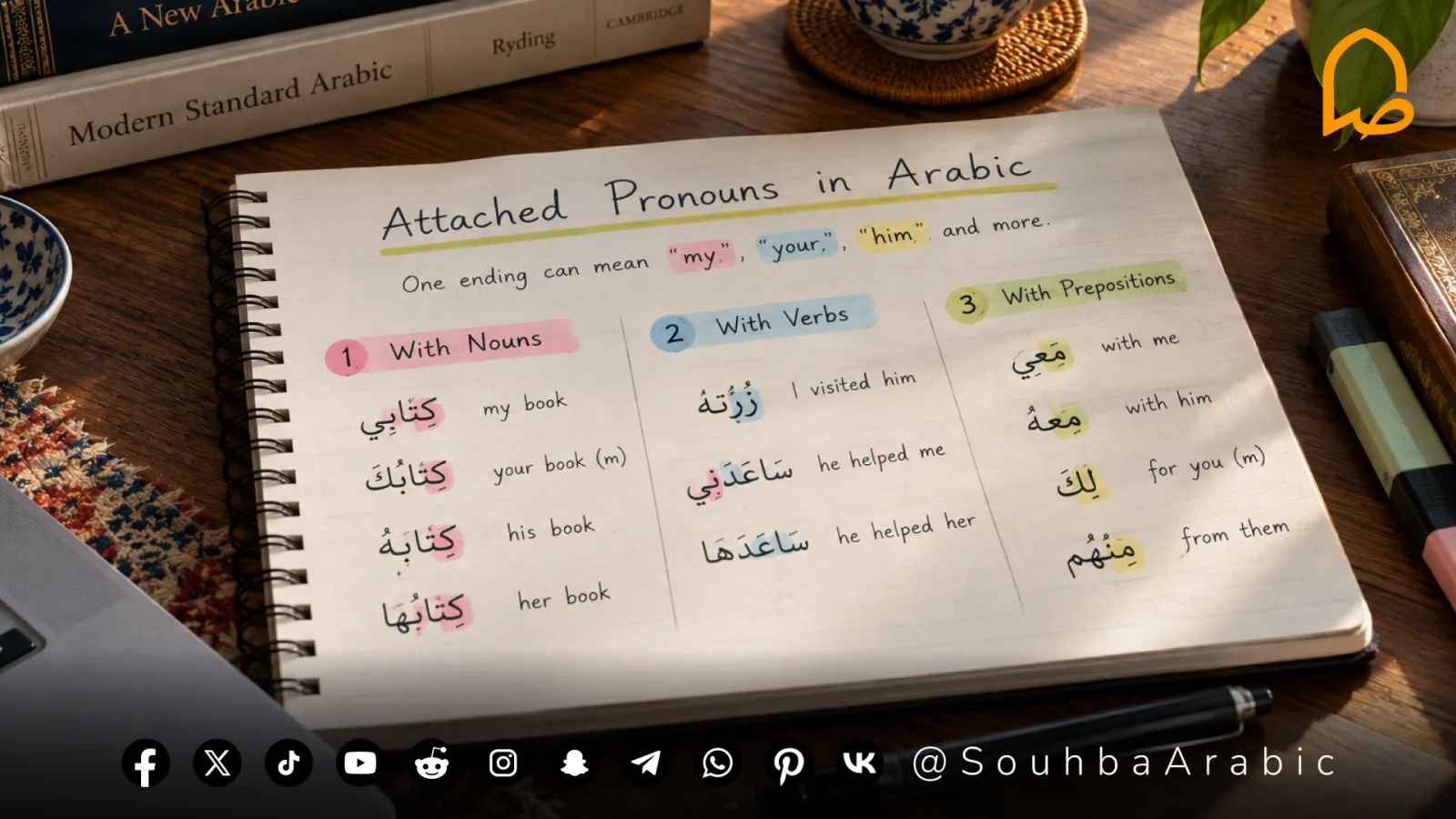
| كِتَابِي | kitābī | my book |
| كِتَابُكَ | kitābuka | your book, when speaking to a man |
| كِتَابُهُ | kitābuhu | his book |
| زُرْتُهُ | zurtuhu | I visited him |
| مَعَهُ | maʿahu | with him |
The important thing to notice is that the same ending can have different meanings depending on the word it attaches to.
Once you learn to recognize these endings, longer Arabic words become easier to understand because you can identify the parts that carry the meaning.
What Are Attached Pronouns in Arabic?
When you first learn Arabic, you usually meet independent pronouns—words that stand on their own, such as:
| Arabic | Transliteration | Meaning |
|---|---|---|
| أَنَا | anā | I |
| أَنْتَ | anta | you, speaking to a man |
| أَنْتِ | anti | you, speaking to a woman |
| هُوَ | huwa | he |
| هِيَ | hiya | she |
Attached pronouns work differently. They cannot stand alone; they connect to the end of another word.
Compare these two sentences:
| Arabic | Transliteration | Meaning |
|---|---|---|
| هَذَا كِتَابٌ | Hādhā kitābun | This is a book. |
| هَذَا كِتَابِي | Hādhā kitābī | This is my book. |
The base noun is the same: كِتَاب (kitāb). Adding ـِي changes its meaning from "a book" to "my book."
What the ending means depends on the type of word it attaches to:
| Attached to | Function | Example |
|---|---|---|
| Nouns | Shows possession | "my book" |
| Verbs | Identifies the person or thing receiving the action | "I visited him" |
| Prepositions and similar expressions | Completes a phrase | "with him" or "for me" |
Let's look at each situation with examples you can use to recognize the pattern in real Arabic sentences.
1. Attached Pronouns With Nouns: My Book, Your House, His Name
In English, the possessive word comes before the noun: my book, your house, her name.
In Arabic, the noun comes first, and the possessive pronoun attaches to its end.
| Arabic | Transliteration | Meaning |
|---|---|---|
| كِتَابِي | kitābī | My book |
| كِتَابُكَ | kitābuka | Your book, to a man |
| كِتَابُكِ | kitābuki | Your book, to a woman |
| كِتَابُهُ | kitābuhu | His book |
| كِتَابُهَا | kitābuhā | Her book |
| كِتَابُنَا | kitābunā | Our book |
| كِتَابُكُمْ | kitābukum | Your book, to a group |
| كِتَابُهُمْ | kitābuhum | Their book |
The same pattern works with other nouns:
| Arabic | Transliteration | Meaning |
|---|---|---|
| بَيْتِي | baytī | my house |
| بَيْتُكَ | baytuka | your house, to a man |
| بَيْتُهَا | baytuhā | her house |
| اسْمُهُ | ismuhu | his name |
Notice an important detail: كِتَابُكَ and كِتَابُكِ are written differently when vowel marks are included, but both are usually written كتابك in ordinary Arabic text without those marks. You must use context to know whether the speaker is addressing a man or a woman.
Why does the ending of the noun change?
You may have noticed that كِتَابٌ (kitābun) becomes كِتَابُكَ (kitābuka) rather than kitābunuka.
There are two useful things to understand here.
First, the tanwīn disappears.
Tanwīn is the doubled vowel sound at the end of words such as كِتَابٌ (kitābun). When a noun takes an attached possessive pronoun, it no longer takes tanwīn. The noun is now definite because it refers to a particular book: your book, not just a book.
Second, the final vowel depends on the noun's grammatical role.
In كِتَابُكَ (kitābuka), the u on كِتَابُ is a case ending. In another sentence, the noun may take a different case ending. Beginners do not need to master every case rule immediately, but it is helpful to know that the vowel before the suffix is not always fixed.
For now, focus on recognizing the base noun and the attached pronoun. You can learn the case rules gradually as you read more Arabic.
2. Attached Pronouns With Verbs: I Visited Him
Attached pronouns also appear on verbs. Here, they can tell you who receives the action.
Look at this sentence:
| Arabic | Transliteration | Meaning |
|---|---|---|
| زُرْتُهُ | Zurtuhu | I visited him. |
The word contains two meaningful parts:
| Part | Arabic | Transliteration | Meaning |
|---|---|---|---|
| Verb | زُرْتُ | zurtu | I visited |
| Object pronoun | ـهُ | -hu | him |
Put them together and you get زُرْتُهُ: "I visited him."
This is a particularly useful example because it contains two different grammatical pieces.
The ـتُ (-tu) in زُرْتُ identifies the subject: I visited. The ـهُ (-hu) identifies the object: I visited him.
In traditional Arabic grammar, both forms belong to the broader category of attached pronouns. For learning purposes, however, it helps to treat them as two separate jobs: one tells you who performs the action, and the other tells you who receives it.
Here are more examples of object pronouns attached to verbs:
| Arabic | Transliteration | Meaning |
|---|---|---|
| سَاعَدَنِي | sāʿadanī | He helped me |
| سَاعَدَكَ | sāʿadaka | He helped you, a man |
| سَاعَدَهُ | sāʿadahu | He helped him |
| سَاعَدَهَا | sāʿadahā | He helped her |
| سَاعَدَنَا | sāʿadanā | He helped us |
Why is "me" sometimes ـنِي rather than ـِي?
Compare the following:
| Arabic | Transliteration | Meaning |
|---|---|---|
| كِتَابِي | kitābī | my book |
| سَاعَدَنِي | sāʿadanī | he helped me |
Both express a relationship to the speaker, but they attach to different kinds of words.
With a noun, ـِي (-ī) commonly expresses possession: my book.
With many verbs, the first-person object form appears as ـنِي (-nī): helped me, visited me, or asked me. The ن is part of the conventional form used with the first-person object suffix in these constructions. It is not a separate word, and you should learn the complete pattern rather than try to remove it.
A common beginner mistake is to assume that every pronoun must have exactly the same form everywhere. Arabic does not work that way. The form you need depends partly on what the pronoun attaches to.
3. Attached Pronouns With Prepositions and Similar Expressions
You will also see attached pronouns after words such as لِـ (li-, "for/to") and مِنْ (min, "from"), and after expressions such as مَعَ (maʿa, "with").
For beginners, the practical pattern is straightforward: the expression comes first, and the pronoun attaches to it.
| Arabic | Transliteration | Meaning |
|---|---|---|
| لِي | lī | For me / to me |
| لَكَ | laka | For you / to you, a man |
| لَهُ | lahu | For him / to him |
| مَعِي | maʿī | With me |
| مَعَكَ | maʿaka | With you, a man |
| مَعَهُ | maʿahu | With him |
| مِنْهُمْ | minhum | From them |
Now put them into simple sentences:
| Arabic | Transliteration | Meaning |
|---|---|---|
| الْكِتَابُ لِي | Al-kitābu lī | The book is mine. |
| هُوَ مَعِي | Huwa maʿī | He is with me. |
| ذَهَبْتُ مَعَهُ | Dhahabtu maʿahu | I went with him. |
One small grammar note: مَعَ (maʿa) is classified more precisely in traditional Arabic grammar as an expression of accompaniment, rather than simply as a preposition in the same category as مِنْ. For a beginner, though, it is useful to learn the pattern alongside prepositions because the pronoun attaches in a similar way.
4. Attached Pronouns Inside Longer Expressions
Once you recognize attached pronouns on nouns, verbs, and prepositions, you can start spotting them inside longer expressions.
For example:
| Arabic | Transliteration | Meaning |
|---|---|---|
| لِأَنِّي أَتَعَلَّمُ الْعَرَبِيَّةَ | Liʾannī ataʿallamu al-ʿarabiyyata | Because I am learning Arabic. |
The expression لِأَنِّي (liʾannī) means "because I." It contains لِأَنَّ (liʾanna, "because") and the attached first-person pronoun ـِي (-ī).
Here is another example:
| Arabic | Transliteration | Meaning |
|---|---|---|
| أُحِبُّ الْعَرَبِيَّةَ لِأَنِّي أَتَعَلَّمُهَا | Uḥibbu al-ʿarabiyyata liʾannī ataʿallamuhā | I love Arabic because I am learning it. |
In أَتَعَلَّمُهَا (ataʿallamuhā), the ending ـهَا (-hā) refers back to الْعَرَبِيَّةَ (al-ʿarabiyyata), the Arabic language. Arabic treats this noun as grammatically feminine, so the feminine suffix is used. In English, the natural translation is "it," even though the Arabic suffix is the same form used for "her."
This is an important distinction: Arabic pronoun suffixes agree with grammatical gender, which does not always match how English speakers think about a person or thing.
A Quick Reference: Common Attached Pronouns
Use this table as a starting point. The examples show common forms, not every possible grammatical use.
| Person | With a noun: "book" | With a verb: "helped" | With an expression: "with" |
|---|---|---|---|
| Me | كِتَابِي — my book | سَاعَدَنِي — helped me | مَعِي — with me |
| You, a man | كِتَابُكَ — your book | سَاعَدَكَ — helped you | مَعَكَ — with you |
| You, a woman | كِتَابُكِ — your book | سَاعَدَكِ — helped you | مَعَكِ — with you |
| Him | كِتَابُهُ — his book | سَاعَدَهُ — helped him | مَعَهُ — with him |
| Her | كِتَابُهَا — her book | سَاعَدَهَا — helped her | مَعَهَا — with her |
| Us | كِتَابُنَا — our book | سَاعَدَنَا — helped us | مَعَنَا — with us |
| Them | كِتَابُهُمْ — their book | سَاعَدَهُمْ — helped them | مَعَهُمْ — with them |
You may notice that the vowel on ـهُ (-hu) sometimes appears as ـهِ (-hi), as in فِي بَيْتِهِ (fī baytihi, "in his house"). This is a pronunciation adjustment found in particular sound environments, especially after an i vowel or y sound. It is not a different pronoun or meaning.
You do not need to memorize every variation at once. Start by learning to recognize the suffix and then notice how it is pronounced in the sentence.
Common Mistakes to Avoid
1. Looking up the entire word instead of its base form
If you cannot find كِتَابِي in a dictionary, try كِتَاب (kitāb). The dictionary may list the base noun rather than every form with a pronoun attached.
2. Assuming one suffix always has one English meaning
The ending ـهُ can mean "his" when attached to a noun, as in كِتَابُهُ ("his book"), or "him" when attached to a verb, as in زُرْتُهُ ("I visited him").
3. Confusing the subject and the object
In زُرْتُهُ (zurtuhu), ـتُ tells you who performed the action: "I." The ending ـهُ tells you who received it: "him."
4. Expecting Arabic and English to organize meaning in the same way
English uses separate words such as "my," "with," and "him." Arabic often attaches pronouns directly to another word. Rather than translating one letter at a time, learn to identify the base word and the function of its ending.
Test Yourself: Can You Recognize the Ending?
Try answering these before checking the solutions.
1. What does كِتَابِي (kitābī) mean?
- A. His book
- B. My book
- C. Your book
2. In زُرْتُهُ (zurtuhu), what does ـهُ mean?
- A. I
- B. His
- C. Him
3. What does مَعَهَا (maʿahā) mean?
- A. With her
- B. For her
- C. From her
4. In سَاعَدَنِي (sāʿadanī), which part means "me"?
- A. سَاعَدَ
- B. ـنِي
- C. ـهُ
5. What should you usually look up first if you cannot find كِتَابِي in a dictionary?
- A. كِتَاب
- B. هُوَ
- C. مَعَ
Answers
| Question | Answer | Explanation |
|---|---|---|
| 1 | B — My book | The suffix ـِي expresses possession. |
| 2 | C — Him | The suffix is attached to a verb and marks its object. |
| 3 | A — With her | مَعَ means "with," and ـهَا refers to a feminine person or noun. |
| 4 | B — ـنِي | This is the first-person object form in this verb construction. |
| 5 | A — كِتَاب | Start with the base noun and identify the attached suffix. |
A Simple Habit for Reading Arabic
The next time you meet a long Arabic word, pause and ask yourself three questions:
1. What is the base word?Is it a noun, verb, or expression?
2. What ending is attached to it?Can you recognize ـِي, ـنِي, ـكَ, ـهُ, ـهَا, ـنَا, or ـهُمْ?
3. What job is the ending doing?Is it showing possession, identifying the object of a verb, or completing an expression?
You do not need to master every suffix in one sitting. Begin with three examples:
| Arabic | Transliteration | Meaning |
|---|---|---|
| كِتَابِي | kitābī | my book |
| زُرْتُهُ | zurtuhu | I visited him |
| مَعَهُ | maʿahu | with him |
Learn to recognize them in context, then look for the same patterns when you read or listen to Arabic.
The goal is not to translate every ending perfectly on your first attempt. It is to start seeing how Arabic words are built.
Master the Arabic Language
Learn Egyptian Arabic, MSA, or Quran & Tajweed 1-on-1 with patient native tutors.
Free 30-minute trial · no card needed