How to Say "The" in Arabic: The Definite Article Explained
If you've ever wondered how to say "the" in Arabic, the answer is two letters: الـ (al-). But beginners quickly notice it's not that simple — sometimes it sounds like al-, sometimes like ash- or ar-, the noun's ending keeps changing, and it behaves differently in possessive phrases. A practical guide to how الـ actually works in MSA: sun and moon letters, tanwīn, adjective agreement, and real examples you can practice reading.
Nady
Sep 24, 2026 • 9 min read
The Arabic الـ: How “Al-” Works in Modern Standard Arabic
If you are learning Modern Standard Arabic (MSA), you will see these two letters everywhere:
الـ
They are usually transliterated as al- and often correspond to English “the.”
For example:
| Arabic | English |
|---|---|
| كِتَابٌ | a book |
| الْكِتَابُ | the book |
The basic idea is easy. The confusing part comes when you start reading and listening to real Arabic:
- Why do you sometimes hear al-, but sometimes ash-, ar-, or an-?
- Why does the ending change?
- Why do you sometimes see الـ in the middle of a phrase but not hear the initial a?
This guide takes these questions one at a time, using practical MSA examples.
Note: This article focuses on Modern Standard Arabic (MSA). Egyptian Arabic and other spoken varieties also use الـ, but pronunciation and usage can differ.
The 3 Things to Check
Whenever you see الـ, ask:
- Does it make the noun definite?
- Is the next letter a sun letter or a moon letter?
- Is the word being pronounced on its own or connected to the word before it?
These three questions explain most of what beginners need to know.
1. What Does الـ Mean?
Arabic uses الـ to make a noun definite.
In simple terms:
| Arabic | English |
|---|---|
| كِتَابٌ | a book |
| الْكِتَابُ | the book |
More examples:
| Indefinite | Definite | English |
|---|---|---|
| بَيْتٌ | الْبَيْتُ | a house → the house |
| طَالِبٌ | الطَّالِبُ | a student → the student |
| مَسْجِدٌ | الْمَسْجِدُ | a mosque → the mosque |
The Arabic grammatical term for the definite article is:
أَدَاةُ التَّعْرِيفِ
One important change happens at the same time: tanwīn disappears.
كِتَابٌ → الْكِتَابُ
You do not normally say:
❌ الْكِتَابٌ
Instead, the noun takes the appropriate grammatical ending:
| Arabic |
|---|
| الْكِتَابُ |
| الْكِتَابَ |
| الْكِتَابِ |
We will look at these endings later.
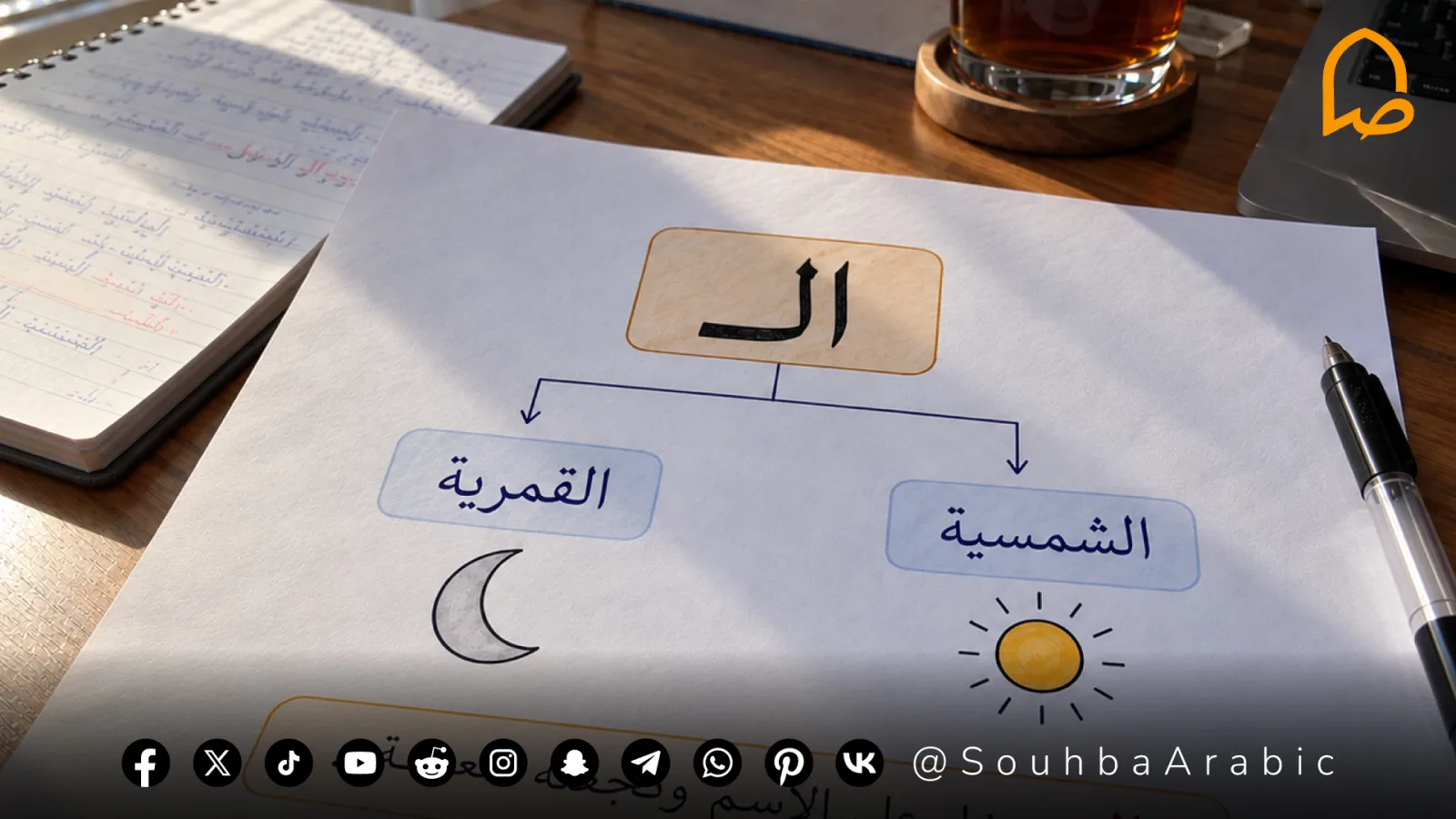
2. Sun Letters and Moon Letters
This is the part that usually surprises beginners.
The الـ is always written the same way, but the ل is not always pronounced as a separate l.
Arabic divides the letters that can follow الـ into two traditional groups:
| Arabic | English |
|---|---|
| حُرُوفٌ قَمَرِيَّةٌ | moon letters |
| حُرُوفٌ شَمْسِيَّةٌ | sun letters |
Here is the complete comparison:
| Group | Letters |
|---|---|
| Moon letters | ا ب ج ح خ ع غ ف ق ك م هـ و ي |
| Sun letters | ت ث د ذ ر ز س ش ص ض ط ظ ل ن |
The key difference is simple:
- Moon letter → pronounce the ل
- Sun letter → the ل is assimilated into the following letter
The spelling of الـ itself does not change.
3. Moon Letters: You Hear the ل
With a moon letter, the ل is pronounced clearly.
For example:
| Arabic | Transliteration | English |
|---|---|---|
| الْقَمَرُ | al-qamaru | the moon |
You can hear the l:
al-qamaru
More examples:
| Arabic | Transliteration | English |
|---|---|---|
| الْكِتَابُ | al-kitābu | the book |
| الْبَيْتُ | al-baytu | the house |
| الْمَسْجِدُ | al-masjidu | the mosque |
| الْقَلَمُ | al-qalamu | the pen |
So:
| Arabic | Result |
|---|---|
| ال + ق | الْقَمَرُ |
| ال + ك | الْكِتَابُ |
| ال + ب | الْبَيْتُ |
The ل remains clearly audible.
The 14 Moon Letters
The moon letters are:
ا ب ج ح خ ع غ ف ق ك م هـ و ي
You do not need to memorize all 14 immediately. The important thing is to understand what they do:
the ل is pronounced.
4. Sun Letters: Why You Hear Ash-, Ar-, An-, etc.
With a sun letter, the ل is written but is not pronounced as a separate l.
Instead, its sound is assimilated into the following consonant.
The classic example is:
| Arabic | English |
|---|---|
| شَمْسٌ | a sun |
| الشَّمْسُ | the sun |
You write:
الشَّمْسُ
But pronounce:
ash-shamsu
Not:
al-shamsu
The ش has a shaddah (ّ) because the consonant is doubled in pronunciation.
The same thing happens with other sun letters:
| Arabic | Transliteration | English |
|---|---|---|
| الرَّجُلُ | ar-rajulu | the man |
| النَّهَارُ | an-nahāru | the day |
| الطَّالِبُ | aṭ-ṭālibu | the student |
| السَّمَاءُ | as-samāʾu | the sky |
| الدَّرْسُ | ad-darsu | the lesson |
So the important rule is:
The spelling stays the same. The pronunciation changes.
You still write:
الشَّمْسُ
You simply do not pronounce the ل separately.
The 14 Sun Letters
They are:
ت ث د ذ ر ز س ش ص ض ط ظ ل ن
A useful way to learn them is through examples rather than trying to memorize a long list immediately:
| Arabic | Transliteration | English |
|---|---|---|
| التِّلْمِيذُ | at-tilmīḏu | the pupil |
| الثَّوْبُ | ath-thawbu | the garment |
| الدَّرْسُ | ad-darsu | the lesson |
| الذَّهَبُ | adh-dhahabu | the gold |
| الرَّجُلُ | ar-rajulu | the man |
| الزَّهْرَةُ | az-zahratu | the flower |
| السَّمَكُ | as-samaku | the fish |
| الشَّمْسُ | ash-shamsu | the sun |
| الصَّبْرُ | aṣ-ṣabru | patience |
| الضَّيْفُ | aḍ-ḍayfu | the guest |
| الطَّالِبُ | aṭ-ṭālibu | the student |
| الظَّهْرُ | aẓ-ẓahru | noon |
| اللَّيْلُ | al-laylu | the night |
| النَّهَارُ | an-nahāru | the day |
Notice something interesting with ل itself:
| Arabic | Transliteration |
|---|---|
| اللَّيْلُ | al-laylu |
There is still an l sound, but the ل of الـ has assimilated into the following ل, so the result is a doubled l sound.
5. What Happens to the Ending?
This is a separate issue from الـ.
Adding الـ makes the noun definite, but it does not decide whether the noun ends in:
ـُ / ـَ / ـِ
The ending depends on the noun's grammatical role in the sentence.
Look at the same word:
Subject
| Arabic | English |
|---|---|
| الْكِتَابُ جَدِيدٌ. | The book is new. |
الْكِتَابُ ends in ـُ because it is the subject.
Object
| Arabic | English |
|---|---|
| قَرَأْتُ الْكِتَابَ. | I read the book. |
Now it is:
الْكِتَابَ
because it is the object.
After a preposition
| Arabic | English |
|---|---|
| فِي الْكِتَابِ. | In the book. |
Now it is:
الْكِتَابِ
because it follows فِي.
So:
| Arabic |
|---|
| الْكِتَابُ |
| الْكِتَابَ |
| الْكِتَابِ |
are all the same noun: “the book.”
The الـ has not changed.
The final vowel changed because the grammatical role changed.
6. الـ and Tanwīn
You will often first learn an indefinite noun with tanwīn:
| Arabic | English |
|---|---|
| كِتَابٌ | a book |
When you make it definite with الـ, the tanwīn disappears:
| Arabic | English |
|---|---|
| الْكِتَابُ | the book |
More examples:
| Indefinite | Definite |
|---|---|
| طَالِبٌ | الطَّالِبُ |
| بَيْتٌ | الْبَيْتُ |
| مَدْرَسَةٌ | الْمَدْرَسَةُ |
So remember:
Indefinite:
كِتَابٌ
Definite:
الْكِتَابُ
Not:
❌ الْكِتَابٌ
7. الـ and Adjectives
This is another pattern you will see constantly in MSA.
An adjective describing a definite noun must also be definite.
Compare:
| Arabic | English |
|---|---|
| كِتَابٌ جَدِيدٌ | a new book |
Both words are indefinite.
Make them definite:
| Arabic | English |
|---|---|
| الْكِتَابُ الْجَدِيدُ | the new book |
Both now have الـ.
Another example:
| Indefinite | Definite | English |
|---|---|---|
| طَالِبٌ مُجْتَهِدٌ | الطَّالِبُ الْمُجْتَهِدُ | a hardworking student → the hardworking student |
And:
| Indefinite | Definite | English |
|---|---|---|
| سَيَّارَةٌ جَدِيدَةٌ | السَّيَّارَةُ الْجَدِيدَةُ | a new car → the new car |
This gives you a useful beginner pattern:
indefinite noun + indefinite adjective
كِتَابٌ جَدِيدٌ
↓
definite noun + definite adjective
الْكِتَابُ الْجَدِيدُ
The adjective also agrees with the noun in other ways, such as gender, number, and case. But for now, focus on the important point for الـ:
If the noun is definite, its adjective is definite too.
8. What About Possession?
Here is a common situation where beginners expect to see الـ but don't.
Arabic often expresses possession using a structure called الإِضَافَةُ (iḍāfah).
For example:
| Arabic | English |
|---|---|
| كِتَابُ الطَّالِبِ | the student's book |
A beginner might expect:
❌ الْكِتَابُ الطَّالِبِ
But that is not how this structure works.
The first noun does not take الـ.
The second noun can be definite:
كِتَابُ الطَّالِبِ
More examples:
| Arabic | English |
|---|---|
| بَابُ الْبَيْتِ | the door of the house |
| مُدَرِّسُ اللُّغَةِ | the language teacher |
| كِتَابُ الْعَرَبِيَّةِ | the Arabic book |
| بَابُ الْمَسْجِدِ | the door of the mosque |
You will encounter this structure constantly in MSA, especially in academic, formal, and Islamic texts.
9. Does الـ Always Mean One Specific “The”?
No.
Sometimes الـ gives a noun a general or generic meaning, rather than referring to one particular object.
For example:
الْإِنْسَانُ ضَعِيفٌ.
This can naturally be translated:
Human beings are weak.
It does not necessarily mean one particular human being.
Another example:
الْعِلْمُ مُهِمٌّ.
Knowledge is important.
So when you see الـ, do not automatically assume that English “the” will be the best translation.
Context matters.
10. What Happens When You Connect الـ to the Previous Word?
There is one more pronunciation rule that beginners often miss.
Look at:
| Arabic | Transliteration |
|---|---|
| الْبَيْتُ | al-baytu |
When you start the word by itself, you pronounce the initial vowel:
al-baytu
But when الـ follows another word, that initial vowel is normally not pronounced separately in connected speech.
For example:
| Arabic | English |
|---|---|
| فِي الْبَيْتِ | in the house |
In connected pronunciation:
fī l-bayti
The spelling has not changed:
فِي الْبَيْتِ
But when the words flow together, the initial vowel of الـ is not pronounced as a separate syllable.
You will see this in many common phrases:
| Arabic | English |
|---|---|
| مِنَ الْبَيْتِ | from the house |
| إِلَى الْمَدْرَسَةِ | to the school |
| وَالْكِتَابُ | and the book |
| بِالْقَلَمِ | with the pen |
This is related to هَمْزَةُ الْوَصْلِ (hamzat al-waṣl), the “connecting hamzah.”
For a beginner, you do not need to master the full theory yet. Just remember:
At the beginning: al-baytu
After another word: l-bayti in connected pronunciation.
11. Put the Rules Together
Now let's combine the ideas.
Example 1: Moon letter
الْكِتَابُ
- الـ makes the noun definite.
- ك is a moon letter.
- The ل is pronounced.
al-kitābu
the book
Example 2: Sun letter
الشَّمْسُ
- الـ makes the noun definite.
- ش is a sun letter.
- The ل is assimilated into ش.
ash-shamsu
the sun
Example 3: Different grammatical ending
قَرَأْتُ الْكِتَابَ
- الـ makes كِتَاب definite.
- ك is a moon letter, so the ل is pronounced.
- الْكِتَابَ is the object, so it ends in ـَ.
I read the book.
Example 4: After a preposition
فِي الْمَدْرَسَةِ
- الـ makes مَدْرَسَة definite.
- م is a moon letter.
- فِي causes the noun to take ـِ.
- In connected speech, the initial vowel of الـ is not pronounced separately.
fī l-madrasati
in the school
Example 5: Definite adjective
الطَّالِبُ الْمُجْتَهِدُ
Both the noun and adjective are definite.
aṭ-ṭālibu l-mujtahidu
the hardworking student
Example 6: Iḍāfah
كِتَابُ الطَّالِبِ
This is an iḍāfah construction:
the student's book
The first noun does not take الـ.
12. A Quick Reading Practice
Try reading these before looking at the answers.
- الْكِتَابُ
- الشَّمْسُ
- الرَّجُلُ
- الْقَمَرُ
- فِي الْبَيْتِ
- الطَّالِبُ الْمُجْتَهِدُ
- قَرَأْتُ الْكِتَابَ
- كِتَابُ الطَّالِبِ
- النَّهَارُ طَوِيلٌ
- بَابُ الْمَسْجِدِ
Answers
| Arabic | Transliteration | English |
|---|---|---|
| الْكِتَابُ | al-kitābu | the book |
| الشَّمْسُ | ash-shamsu | the sun |
| الرَّجُلُ | ar-rajulu | the man |
| الْقَمَرُ | al-qamaru | the moon |
| فِي الْبَيْتِ | fī l-bayti | in the house |
| الطَّالِبُ الْمُجْتَهِدُ | aṭ-ṭālibu l-mujtahidu | the hardworking student |
| قَرَأْتُ الْكِتَابَ | qaraʾtu l-kitāba | I read the book |
| كِتَابُ الطَّالِبِ | kitābu ṭ-ṭālibi | the student's book |
| النَّهَارُ طَوِيلٌ | an-nahāru ṭawīlun | the day is long |
| بَابُ الْمَسْجِدِ | bābu l-masjidi | the door of the mosque |
The Short Version
If you are just starting, remember these four patterns first:
- الـ makes a noun definite
| Arabic | English |
|---|---|
| كِتَابٌ → الْكِتَابُ | a book → the book |
- Moon letter → pronounce ل
| Arabic | Transliteration |
|---|---|
| الْقَمَرُ | al-qamaru |
- Sun letter → assimilate ل
| Arabic | Transliteration |
|---|---|
| الشَّمْسُ | ash-shamsu |
- Connected speech → the initial vowel of الـ may disappear
| Arabic | Transliteration |
|---|---|
| فِي الْبَيْتِ | fī l-bayti |
Then remember that the final vowel is a separate grammatical issue:
| Arabic |
|---|
| الْكِتَابُ |
| الْكِتَابَ |
| الْكِتَابِ |
And when a noun has a definite adjective:
| Indefinite | Definite |
|---|---|
| كِتَابٌ جَدِيدٌ | الْكِتَابُ الْجَدِيدُ |
Once these patterns become familiar, الـ stops being something you have to translate every time you see it. You start recognizing what it is doing while you read.
That is the real goal of learning grammar: not memorizing rules for their own sake, but using them to understand real Arabic more naturally.
If you want someone to listen while you read ash-shamsu, ar-rajulu, or al-qamaru and correct you as you go, that kind of guided practice can make these patterns much easier to internalize. At Souhba, you can start with a free 30-minute trial and build your lessons around the Arabic you actually want to read and understand.
Master the Arabic Language
Learn Egyptian Arabic, MSA, or Quran & Tajweed 1-on-1 with patient native tutors.
Free 30-minute trial · no card needed