Arabic Wedding Phrases You Will Actually Hear
Learn the Arabic phrases you’ll actually hear at weddings, from everyday congratulations like “Mabrook” and “Alf Mabrook” to blessings like “Barak Allahu Lakuma.” Includes useful Egyptian Arabic and Islamic expressions with their meanings and when to use them.
Nady
Sep 14, 2026 • 6 min read
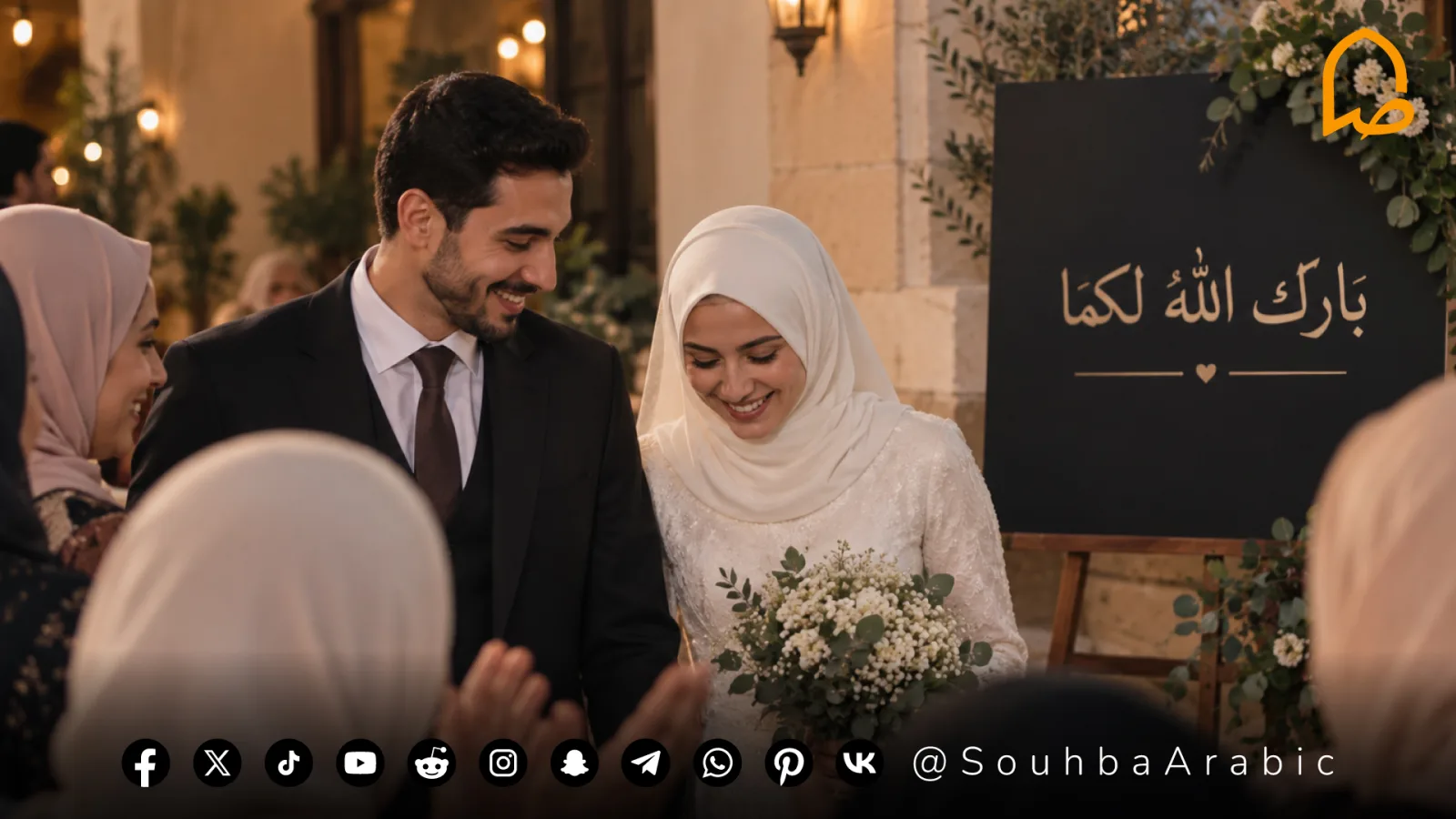
If you attend a Muslim or Arabs' wedding, you will probably hear several Arabic expressions of congratulations and du'a.
One of the most beautiful is:
بارك الله لكما
Baraka Allahu lakuma
“May Allah bless you both.”
But you may also hear:
مبروك!
Mabrūk!
“Congratulations!”
or:
ألف مبروك!
Alf mabrook!
“A thousand congratulations!”
So which one should you actually use?
Let's look at the phrases you're most likely to hear—and the difference between them.
1. بارك الله لكما — May Allah Bless You Both
بارك الله لكما
Baraka Allahu lakuma
“May Allah bless you both.”
This is a du'a, or supplication. You are asking Allah to place blessing in the couple's life.
The phrase breaks down simply:
-
بارك (bāraka) — bless
-
الله (Allāh) — Allah
-
لكما (lakumā) — for you both
The كما ending is important: لكما addresses two people.
You can say this directly to a bride and groom:
بارك الله لكما.
It is also common to see the phrase written in wedding congratulations and messages.
An important detail for Arabic learners
If you are quoting the well-known prophetic wedding blessing specifically, its wording is slightly different:
بارك الله لك، وبارك عليك، وجمع بينكما في خير
Baraka Allahu laka, wa baraka ʿalayka, wa jamaʿa baynakuma fī khayr.
“May Allah bless you, bless you with His blessings, and bring you both together in goodness.”
This wording is narrated from Abu Hurayrah and is recorded in Sunan Abi Dawud 2130 and Jamiʿ al-Tirmidhi 1091, where al-Tirmidhi graded the narration hasan sahih.
So remember the distinction:
بارك الله لكما = a natural du'a addressed to both people.
بارك الله لك، وبارك عليك، وجمع بينكما في خير = the wording of the well-known prophetic wedding blessing.
2. مبروك — Congratulations!
مبروك!
Mabrūk!
This is probably the simplest wedding greeting you'll hear.
It means:
“Congratulations!”
You can say it to:
-
The bride
-
The groom
-
Both together
-
Their family
For example:
مبروك يا أحمد!
“Congratulations, Ahmed!”
Or simply:
مبروك للعروسين!
“Congratulations to the bride and groom!”
مبروك is not specifically a religious phrase. It is a normal Arabic congratulatory expression and is used for many happy occasions—not just weddings.
You can hear it when someone:
-
Gets married
-
Has a baby
-
Graduates
-
Gets a new job
-
Achieves something important
So if you are unsure what to say at an Arabic wedding:
مبروك!
is always a useful place to start.
3. ألف مبروك — A Thousand Congratulations!
ألف مبروك!
Alf mabrook!
Literally:
“A thousand congratulations!”
This is extremely common in Arabic congratulations, including weddings.
It is simply a warmer, more enthusiastic version of مبروك.
For example:
ألف مبروك يا جماعة!
“A thousand congratulations, everyone!”
Or:
ألف مبروك للعروسين!
“A thousand congratulations to the newlyweds!”
You do not need to interpret ألف literally. It is an emphatic way of expressing strong congratulations.
4. ربنا يبارك لكم — May God Bless You
In Egyptian Arabic, you may also hear:
ربنا يبارك لكم
Rabbena yebarek lakom
“May God bless you.”
Here:
-
ربنا (Rabbena) — our Lord / God
-
يبارك (yebarek) — bless
-
لكم (lakom) — you (plural)
This is a very useful Egyptian expression because ربنا is commonly used in everyday Egyptian speech when making a prayer or good wish.
You might hear someone say:
ألف مبروك، ربنا يبارك لكم.
“Congratulations! May God bless you.”
It works especially naturally in a family or informal setting.
5. ربنا يسعدكم — May God Make You Happy
Another warm Egyptian expression is:
ربنا يسعدكم
Rabbena yesaʿdakum
“May God make you happy.”
This is a lovely phrase to say to newlyweds.
It is less formal than the classical-style wedding du'a and sounds natural in everyday conversation.
You could say:
ألف مبروك، ربنا يسعدكم.
“Congratulations! May God make you happy.”
This is the kind of phrase you are likely to hear from family members and friends because it sounds personal rather than ceremonial.
6. ربنا يهنيكم — May God Grant You Happiness
You may also hear:
ربنا يهنيكم
Rabbena yehannīkom
A natural translation is:
“May God grant you happiness.”
The verb يهني is related to the idea of happiness, comfort, and having an enjoyable life.
It is another warm expression that fits naturally in congratulations to a newly married couple.
For example:
مبروك، ربنا يهنيكم ويسعدكم.
“Congratulations. May God grant you happiness and make you happy.”
You don't need to memorize every possible congratulation. Learning a few natural expressions is much more useful.
7. للعروسين — For the Bride and Groom
If you want to congratulate the couple specifically, you can say:
مبروك للعروسين!
Mabrūk lel-ʿarūsēn!
“Congratulations to the bride and groom!”
العروسين means “the bride and groom” together.
You may see this expression on:
-
Wedding decorations
-
Social media posts
-
Wedding cards
-
Congratulations from friends and family
It is particularly useful vocabulary if you are reading Arabic wedding messages.
What Should You Actually Say?
You don't need a long speech.
Here are a few combinations that sound natural:
Simple
مبروك!
“Congratulations!”
Warm and common
ألف مبروك! ربنا يسعدكم.
“A thousand congratulations! May God make you happy.”
With a religious blessing
ألف مبروك، بارك الله لكما.
“A thousand congratulations. May Allah bless you both.”
A longer traditional blessing
بارك الله لك، وبارك عليك، وجمع بينكما في خير.
“May Allah bless you, bless you with His blessings, and bring you both together in goodness.”
You can choose the expression according to the situation. You don't need to sound formal if you're congratulating a friend, and you don't need to use a long du'a if a simple مبروك feels more natural.
Egyptian Arabic or Formal Arabic?
This is a useful distinction for Arabic learners.
مبروك and ألف مبروك are widely understood across the Arabic-speaking world.
Expressions beginning with ربنا are especially natural in Egyptian everyday speech, although similar prayers are certainly not limited to Egypt.
The prophetic wedding du'a belongs to a different register: it is a religious supplication preserved in hadith.
So you might hear all of these at the same wedding:
مبروك!
****ألف مبروك!
****ربنا يسعدكم.
**بارك الله لكما.
They don't all have to be treated as competing translations.
They are different ways of congratulating someone, making a good wish, or making du'a for the couple.
One Small Arabic Lesson
There is a useful grammar point hidden in لكما.
Arabic has a special grammatical form for two people.
Compare:
لكَ — for you, one male
لكِ — for you, one female
لكما — for you both
So:
بارك الله لكما
literally addresses two people.
This is one reason Arabic wedding expressions are useful for learners: you're learning real language while also seeing how Arabic grammar works in context.
What to Remember
If you're going to an Arabic-speaking wedding, you only need a few phrases to get started:
مبروك!
Congratulations!
ألف مبروك!
A thousand congratulations!
ربنا يسعدكم.
May God make you happy.
ربنا يبارك لكم.
May God bless you.
بارك الله لكما.
May Allah bless you both.
And if you want the well-known prophetic wedding blessing:
بارك الله لك، وبارك عليك، وجمع بينكما في خير
These expressions show something important about learning Arabic.
You are not only learning what words mean. You are learning what people actually say, when they say it, and how language connects with culture and faith.
That is where Arabic starts to feel less like a textbook and more like a living language.
Sources
-
Jamiʿ al-Tirmidhi 1091 — the prophetic marriage-congratulation narration.
-
Sunan Abi Dawud 2130 — the same prophetic wedding blessing narrated from Abu Hurayrah.
-
Sahih Muslim — includes an authentic prophetic narration using the dual form لكما in a different context.
Master the Arabic Language
Learn Egyptian Arabic, MSA, or Quran & Tajweed 1-on-1 with patient native tutors.
Free 30-minute trial · no card needed