Every Stranger Is Kin to a Stranger: The Timeless Poetry of Imru’ al-Qais
Explore a poem traditionally attributed to Imru’ al-Qais, with Arabic vowel marks, transliteration, English translation, and accessible explanations of its themes of loneliness, belonging, time, and mortality.

Ahmed
Oct 28, 2026 • 10 min read
Some poems survive for centuries because they express something human beings never stop experiencing: loneliness, the desire to belong, and the realization that time cannot be turned back.
One short Arabic poem, traditionally attributed to the pre-Islamic poet Imru’ al-Qais (امرؤ القيس), explores all three. Its five verses begin with a simple address to a neighbor and end with a striking reflection on death.
At its heart is one memorable line:
وَكُلُّ غَرِيبٍ لِلْغَرِيبِ نَسِيبُ
Wa-kullu gharībin lil-gharībi nasību.
“And every stranger is kin to a stranger.”
You do not need to be an advanced Arabic student to appreciate this poem. Some of its words are still familiar in modern Arabic, while its deeper meaning becomes clearer as we read each verse.
About the Poem at a Glance
| Element | Details |
|---|---|
| Poet | Imru’ al-Qais (امرؤ القيس) |
| Era | Pre-Islamic Arabia |
| Theme | Loneliness, belonging, time, and death |
| Famous Line | وَكُلُّ غَرِيبٍ لِلْغَرِيبِ نَسِيبُ — “And every stranger is kin to a stranger.” |
| Structure | Five verses |
| Opening Address | The poet speaks to a neighbor |
Who Was Imru’ al-Qais?
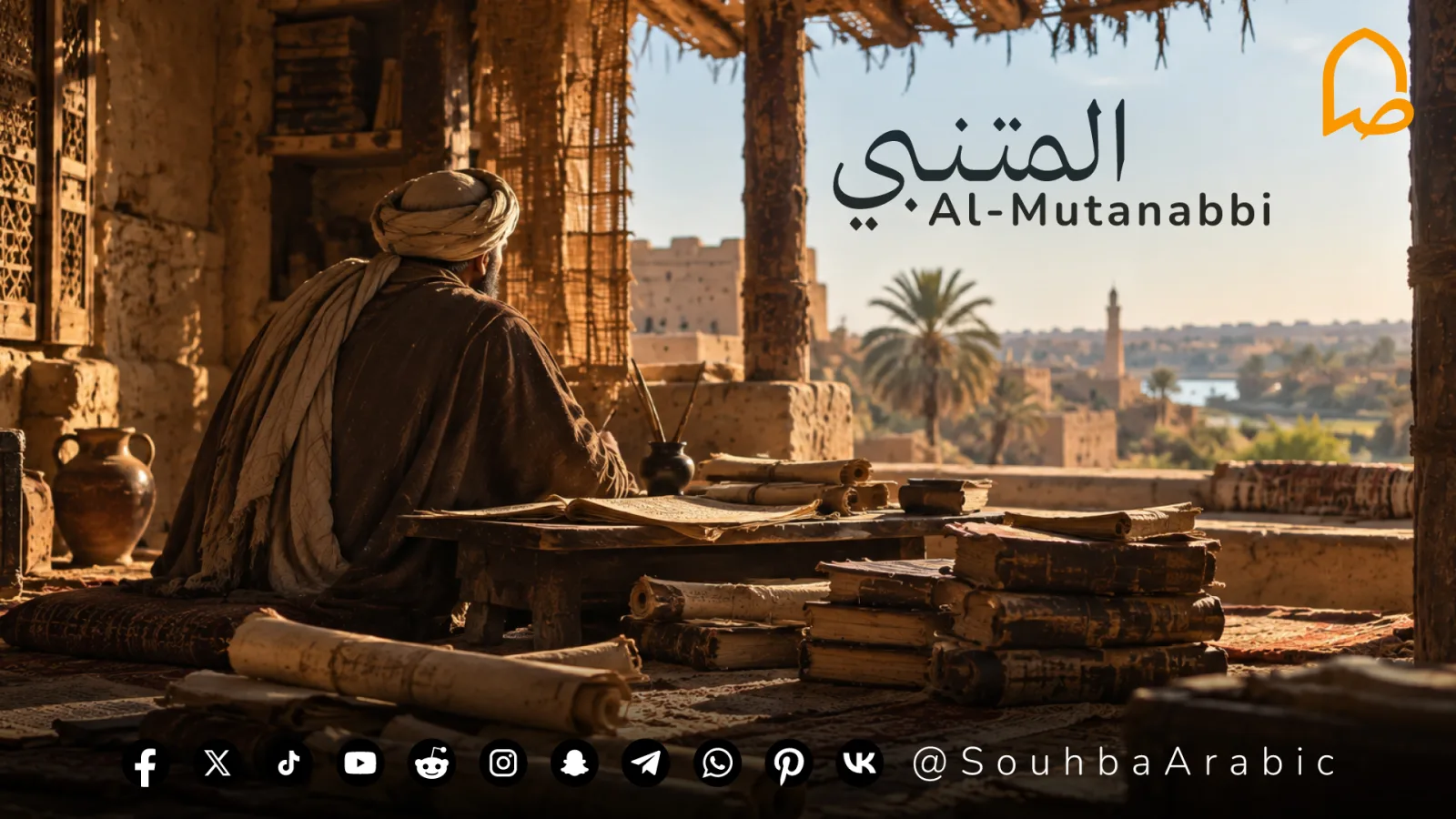
Imru’ al-Qais is one of the best-known poets of pre-Islamic Arabia, the period before the rise of Islam in the seventh century CE. His poetry is an important part of the classical Arabic literary tradition.
Traditional accounts describe him as a man who travelled far from his homeland after losing his father’s kingdom. One literary account connects the final part of his journey with Mount ʿAsīb (عَسِيب), near Ankara, where he is said to have become ill and died.
The story associated with this poem says that he encountered a grave while far from home and addressed its occupant as his neighbor. The account gives the poem a moving setting: two people brought together not by family or birthplace, but by their shared distance from home.
A note on the sources:
This story should be understood as a traditional literary account rather than a fully established historical record. The poem is traditionally attributed to Imru’ al-Qais, but details of its setting and composition should be treated with care.
The Poem: Arabic, Transliteration, and English Translation
The Arabic text below includes vowel marks (tashkīl) to help learners read the verses aloud. The English translation aims to preserve the meaning and feeling of the poem rather than reproduce every word mechanically.
Verse 1 — When Hardships Keep Coming
أَجَارَتَنَا إِنَّ الْخُطُوبَ تَنُوبُ
وَإِنِّي مُقِيمٌ مَا أَقَامَ عَسِيبُ
Transliteration
Ajāratanā inna al-khuṭūba tanūbu, wa-innī muqīmun mā aqāma ʿAsību.
Translation
“O our neighbor, hardships come one after another,
and I shall remain here as long as Mount ʿAsīb stands.”
Reflection
The poem opens by addressing a neighbor. The word الْخُطُوبُ (al-khuṭūb) refers to serious troubles or calamities. The poet acknowledges that hardship is part of life, while declaring that he will remain where he is for as long as the mountain stands.
In the context of the traditional story, the line takes on a sadder meaning. His stay may be far more permanent than an ordinary visit.
Words to Notice
| Arabic | Transliteration | Meaning |
|---|---|---|
| جَارَة | jārah | a female neighbor |
| الْخُطُوب | al-khuṭūb | hardships or calamities |
| مُقِيم | muqīm | staying or residing |
| عَسِيب | ʿAsīb | the name of the mountain in the poem |
Verse 2 — A Stranger Understands Another Stranger
أَجَارَتَنَا إِنَّا غَرِيبَانِ هَاهُنَا
وَكُلُّ غَرِيبٍ لِلْغَرِيبِ نَسِيبُ
Transliteration
Ajāratanā innā gharībāni hāhunā, wa-kullu gharībin lil-gharībi nasību.
Translation
“O our neighbor, we are both strangers here,
and every stranger is kin to a stranger.”
Reflection
This is the poem’s central idea.
The poet and the person he addresses may have no family connection. Yet their shared experience of being far from home creates a different kind of bond.
Think of someone moving to a new country, arriving at a university where they know nobody, or trying to build a life in a place where they do not speak the language well. Meeting another person who understands that experience can make an unfamiliar place feel a little less lonely.
The poem suggests that belonging does not always begin with family ties. Sometimes it begins with recognizing a similar struggle in someone else.
Key idea:
This verse is the emotional heart of the poem. It transforms a simple greeting into a statement about human connection.
Words to Notice
| Arabic | Transliteration | Meaning |
|---|---|---|
| غَرِيب | gharīb | a stranger, foreigner, or person far from home; in modern Arabic, it can also mean “strange,” depending on context |
| غَرِيبَانِ | gharībāni | two strangers |
| نَسِيب | nasīb | a relative or person connected through kinship |
| هَاهُنَا | hāhunā | here, in this place |
Grammar note:
Notice the ending of غَرِيبَانِ. In formal Arabic, the dual form helps show that the poet is speaking about two people.
Verse 3 — Kinship Needs Connection
فَإِنْ تَصِلِينَا فَالْقَرَابَةُ بَيْنَنَا
وَإِنْ تَصْرِمِينَا فَالْغَرِيبُ غَرِيبُ
Transliteration
Fa-in taṣilīnā fal-qarābatu baynanā, wa-in taṣrimīnā fal-gharību gharību.
Translation
“If you draw close to us, then kinship will bind us;
if you turn away, a stranger remains a stranger.”
Reflection
The poet now considers what makes a connection real. Shared circumstances may bring two people close, but a relationship still depends on whether they respond to one another.
The contrast between تَصِلِينَا (taṣilīnā) and تَصْرِمِينَا (taṣrimīnā) is important. The first expresses joining or maintaining a connection; the second means cutting off or severing that connection.
The message is simple: people can remain strangers, or they can choose to build a relationship.
Words to Notice
| Arabic | Transliteration | Meaning |
|---|---|---|
| تَصِلِينَا | taṣilīnā | you connect with us or draw close to us |
| تَصْرِمِينَا | taṣrimīnā | you cut us off or sever the connection |
| الْقَرَابَة | al-qarābah | kinship or a family relationship |
| بَيْنَنَا | baynanā | between us |
Pattern to notice:
You may see the ending ـنَا (-nā) in words such as جَارَتَنَا and بَيْنَنَا. Depending on the word, it can mean “our” or “us.” This is one example of how Arabic attaches pronouns to words rather than always using separate words.
If you want to explore this pattern further, Souhba’s Arabic Attached Pronouns guide is a useful next step.
Verse 4 — The Past Will Not Return
أَجَارَتَنَا مَا فَاتَ لَيْسَ يَؤُوبُ
وَمَا هُوَ آتٍ فِي الزَّمَانِ قَرِيبُ
Transliteration
Ajāratanā mā fāta laysa yaʾūbu, wa-mā huwa ātin fī az-zamāni qarību.
Translation
“O our neighbor, what has passed will not return,
and what is yet to come is near in time.”
Reflection
Here, the poem turns from loneliness to time.
The past is beyond our reach. The future, meanwhile, approaches whether we feel ready for it or not. The verse invites us to consider how quickly life moves and how little control we have over what has already happened.
This idea has a familiar connection to Egyptian Arabic. You may have heard the expression:
اللِّي فَات مَات **Illi fāt māt.
Literally, it means something like “what has passed is dead.” It is commonly used to encourage someone to stop dwelling on the past and move forward. It is not the same expression as the poem’s line, but both draw attention to the fact that what has passed cannot simply be recovered.
Words to Notice
| Arabic | Transliteration | Meaning |
|---|---|---|
| مَا فَاتَ | mā fāta | what has passed |
| يَؤُوبُ | yaʾūbu | returns |
| آتٍ | ātin | coming or approaching |
| الزَّمَان | az-zamān | time |
| قَرِيب | qarīb | near or close |
Verse 5 — Who Is Truly a Stranger?
وَلَيْسَ غَرِيبًا مَنْ تَنَاءَتْ دِيَارُهُ
وَلَكِنَّ مَنْ وَارَى التُّرَابُ غَرِيبُ
Transliteration
Wa-laysa gharīban man tanāʾat diyāruhu, wa-lākinna man wārā at-turābu gharību.
Translation
“A person is not a stranger simply because their homeland is far away;
the one covered by the earth is the stranger.”
Reflection
The final verse changes the meaning of the poem’s central word.
Until now, gharīb has described someone separated from home. In the final line, the poet points toward a deeper separation: death.
A person living far from their homeland can still remember, speak, form friendships, and find a sense of belonging. The person who has died, however, has passed beyond the company of the living.
The image of earth covering the dead gives the verse its force. The poem begins with a stranger seeking connection and ends by reminding us that distance from home is not the greatest separation a human being can experience.
It is a sobering ending, but not an empty one. The poem also reminds us that while we are alive, the connections we make with others still matter.
Words to Notice
| Arabic | Transliteration | Meaning |
|---|---|---|
| تَنَاءَتْ | tanāʾat | became distant or lay far away |
| دِيَارُهُ | diyāruhu | his home or homeland |
| التُّرَاب | at-turāb | earth, soil, or dust |
| غَرِيب | gharīb | stranger or someone separated from familiar surroundings |
What Can Arabic Learners Learn From This Poem?
Classical Arabic poetry can look intimidating at first. The vocabulary, grammar, and style are sometimes very different from everyday conversation. But a short poem like this offers a manageable way to explore the language while discovering something about Arabic literary culture.
1. Recognize Words That Remain Familiar Today
Words such as غَرِيب (gharīb, “stranger”), قَرِيب (qarīb, “near”), زَمَان (zamān, “time”), and تُرَاب (turāb, “earth”) are still used in modern Arabic, although their meaning and use depend on context.
2. Practise Reading With Vowel Marks
The tashkīl helps you identify the intended pronunciation. Try reading one verse slowly, then repeat it without looking at the transliteration. Some grammatical forms belong specifically to classical Arabic, so do not worry if every construction is not immediately familiar.
3. Listen for the Poem’s Repeated Ending Sounds
The verses share a recurring long -ību sound, as in tanūbu, ʿAsību, nasību, and gharību. Reading aloud helps you notice the rhythm and vowel lengths that are easy to miss when reading silently.
4. Learn Through Meaning, Not Memorization Alone
Instead of memorizing a list of isolated words, connect each word to the verse where it appears. Ask yourself why the poet chose that word and how it contributes to the meaning. This makes vocabulary easier to remember.
5. Explore the Relationship Between Classical and Modern Arabic
A classical poem is not a guide to everyday conversation on its own. Still, reading it alongside Modern Standard Arabic and Egyptian Arabic can help you recognize shared vocabulary and appreciate how the language has been used across different periods.
A Final Thought
The line وَكُلُّ غَرِيبٍ لِلْغَرِيبِ نَسِيبُ offers a simple but lasting idea: people who share an experience of being outsiders may find a connection that circumstances alone could never give them.
The poem then goes further. It asks us to look beyond distance, remember how quickly time passes, and recognize the difference between being far from home and being separated from the living altogether.
That is part of what makes classical poetry worth reading today. The language may be old, but the questions it raises are still familiar.
Continue Learning Arabic With Souhba
At Souhba, we believe learning Arabic can be about more than grammar rules and vocabulary lists. It can also open a door to the stories, poetry, and culture carried by the language.
Whether you are beginning with the Arabic alphabet, learning Modern Standard Arabic, practising Egyptian Arabic, or exploring classical texts, a patient, level-appropriate approach can help you move forward.
Explore learning Arabic with Souhba and take the next step in your Arabic journey.
Sources and Further Reading
| Source | Description |
|---|---|
| Al-Diwan: Poem attributed to Imru’ al-Qais | Arabic poem text and attribution. |
| Mawdoo3: Explanation of the poem | Background and interpretation of its vocabulary and themes. Search the site for the opening line: أَجَارَتَنَا إِنَّ الْخُطُوبَ تَنُوبُ |
| Dīwān Imru’ al-Qais, edited by ʿAbd al-Raḥmān al-Muṣṭawī, Dār al-Maʿrifah, 2004 | A printed edition containing the poem and a traditional account associated with Mount ʿAsīb. |
Editorial note:
The poem is traditionally attributed to Imru’ al-Qais. The story connecting it to his final journey is a traditional literary account; its details should not be treated as independently verified historical fact.
Master the Arabic Language
Learn Egyptian Arabic, MSA, or Quran & Tajweed 1-on-1 with patient native tutors.
Free 30-minute trial · no card needed