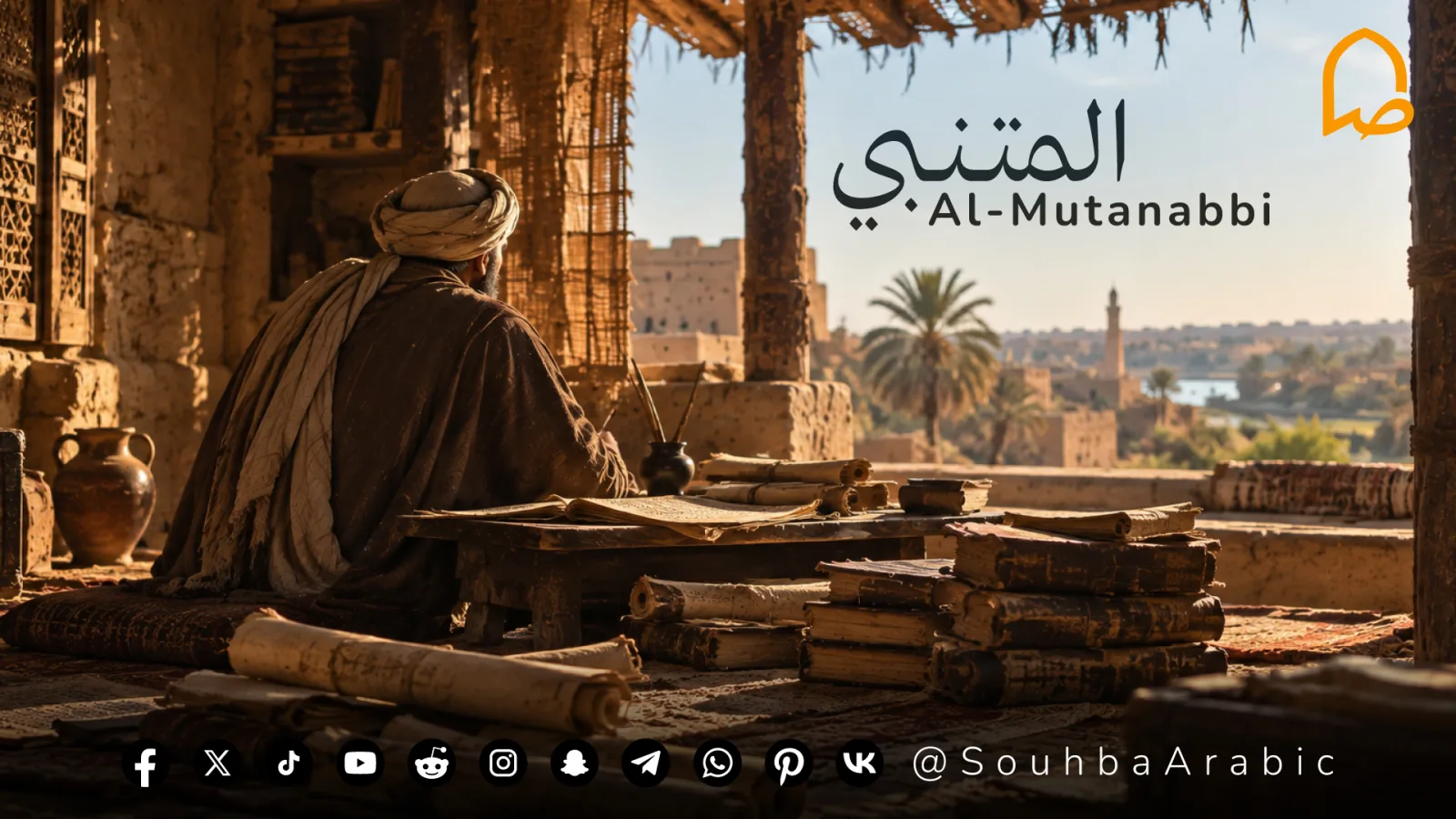
Who Was Al-Mutanabbi? The Poet Whose Words Still Resonate
Discover Al-Mutanabbi, the celebrated 10th-century Arabic poet whose memorable verses explore ambition, generosity, pride, and human nature. Explore three famous couplets and discover what classical Arabic poetry can teach you about language and culture.

Nady
Oct 16, 2026 • 10 min read
عَلَى قَدْرِ أَهْلِ الْعَزْمِ تَأْتِي الْعَزَائِمُ**وَتَأْتِي عَلَى قَدْرِ الْكِرَامِ الْمَكَارِمُ
Great undertakings come in proportion to the resolve of great people, and noble deeds in proportion to the nobility of those who perform them.
More than a thousand years ago, the Arabic poet Al-Mutanabbi wrote these lines about resolve, character, and achievement. They offer a glimpse of why his poetry continues to attract readers.
So what does a 10th-century poet have to do with learning Arabic today?
His work opens a window into classical Arabic, the history of Arabic literature, and the ways writers use language to express ideas with precision and force. His verses explore ambition, generosity, pride, and human nature—subjects that remain meaningful long after the political world in which he lived has disappeared.
You do not need to be an advanced Arabic student to appreciate a famous verse. With a clear translation, a little historical context, and guidance through the language, you can begin to understand what makes it memorable.
Who Was Al-Mutanabbi?
Abu al-Tayyib al-Mutanabbi was a celebrated Arabic poet born in Kufa, in present-day Iraq, around 915 CE, during the Abbasid era. His personal name was Ahmad ibn al-Husayn, and he became one of the most prominent figures in classical Arabic literature.
Quick Facts
| Full Name | Abu al-Tayyib al-Mutanabbi |
| Arabic Name | أَبُو الطَّيِّبِ الْمُتَنَبِّي |
| Birth | Kufa, present-day Iraq, around 915 CE |
| Era | Abbasid era |
| Personal Name | Ahmad ibn al-Husayn |
| Death | 965 CE |
His nickname, Al-Mutanabbi (الْمُتَنَبِّي), is traditionally associated with a claim to prophethood in his youth. Medieval biographical accounts describe a period of religiously framed political rebellion that ended with his imprisonment. As with many details of medieval literary biography, individual accounts should be read with an awareness of the sources through which they have survived.
After his release, Al-Mutanabbi traveled in search of patrons who could support his literary career. His most famous association was with Sayf al-Dawla, the Hamdanid ruler of Aleppo. During the years he spent at Sayf al-Dawla's court, Al-Mutanabbi composed celebrated praise poems connected with the ruler's military campaigns and political achievements.
Their relationship eventually ended, and the poet later traveled to Egypt, where he came into conflict with its ruler, Abu al-Misk Kafur. Al-Mutanabbi continued writing and traveling before he was killed in 965 CE.
His life was shaped by ambition, patronage, rivalry, and the politics of his time. Yet his reputation ultimately rested on something that outlasted those relationships: his poetry.
Three Famous Verses Explained
Al-Mutanabbi's poetry can be challenging for beginners. Its vocabulary, grammar, rhythm, and historical references belong to a literary tradition that differs from everyday conversation. But even a single couplet can reveal something about how classical Arabic expresses an idea.
Here are three well-known examples.
1. On Ambition and Resolve
عَلَى قَدْرِ أَهْلِ الْعَزْمِ تَأْتِي الْعَزَائِمُ**وَتَأْتِي عَلَى قَدْرِ الْكِرَامِ الْمَكَارِمُ
| Transliteration | ʿAlā qadri ahli al-ʿazmi taʾtī al-ʿazāʾimu, wa-taʾtī ʿalā qadri al-kirāmi al-makārimu. |
| Meaning | Great undertakings come in proportion to the resolve of great people, and noble deeds in proportion to the nobility of those who perform them. |
The Context
These are the opening lines of a famous poem praising Sayf al-Dawla. The poem celebrates leadership, courage, and military achievement, reflecting the political and literary culture in which Al-Mutanabbi worked.
What Learners Can Notice
The couplet uses parallel structure: the second line echoes the shape and rhythm of the first while developing its idea.
Notice two pairs of related words:
| Arabic | Transliteration | Meaning |
|---|---|---|
| عَزْمٌ | ʿazm | resolve or determination |
| عَزَائِمُ | ʿazāʾim | firm resolutions or great undertakings |
| كِرَامٌ | kirām | noble or generous people |
| مَكَارِمُ | makārim | noble deeds or qualities |
The repeated structure makes the thought memorable. The verse connects the scale of an undertaking with the resolve of the person who undertakes it, then connects noble actions with the character of those who perform them.
Modern Use: Readers today may use the couplet to express the idea that difficult goals call for determination and that meaningful achievements reflect the people behind them.
2. On Generosity and Human Nature
إِذَا أَنْتَ أَكْرَمْتَ الْكَرِيمَ مَلَكْتَهُ**وَإِنْ أَنْتَ أَكْرَمْتَ اللَّئِيمَ تَمَرَّدَا
| Transliteration | Idhā anta akramta al-karīma malaktahu, wa-in anta akramta al-laʾīma tamarradā. |
| Meaning | If you treat a noble person generously, you win their loyalty; but if you treat a base or ignoble person generously, they may become defiant. |
The Context
The couplet reflects a recurring theme in Al-Mutanabbi's poetry: the relationship between generosity, character, loyalty, and power. As a poet whose career depended partly on patrons, he wrote in a world where personal relationships and political status were closely connected.
The line presents a sharp contrast between two possible responses to generosity. It also reflects the poet's often forceful view of human character.
What Learners Can Notice
Look at the conditional expressions:
| Arabic | Transliteration | Meaning |
|---|---|---|
| إِذَا | idhā | if or when |
| وَإِنْ | wa-in | and if |
The repeated structure helps the contrast stand out. Rather than developing a long argument, the poet presents two contrasting situations in a compact, memorable form.
Note: The word اللَّئِيمُ (al-laʾīm) carries a negative sense, such as base, ignoble, or mean-spirited. Translating it simply as "ungrateful" can narrow its meaning too much.
Interpretation: The couplet expresses a cynical observation about human behavior, not a universal rule that determines how every person will respond to kindness.
3. On Pride and Self-Identity
الْخَيْلُ وَاللَّيْلُ وَالْبَيْدَاءُ تَعْرِفُنِي**وَالسَّيْفُ وَالرُّمْحُ وَالْقِرْطَاسُ وَالْقَلَمُ
| Transliteration | Al-khaylu wa-l-laylu wa-l-baydāʾu taʿrifunī, wa-l-sayfu wa-r-rumḥu wa-l-qirṭāsu wa-l-qalamu. |
| Meaning | The horses, the night, and the open desert know me; so do the sword, the spear, the page, and the pen. |
The Context
This famous couplet presents the poet as someone equally at home in the world of action and the world of words. Horses, night, and the open desert evoke travel and life beyond the city. The sword and spear suggest martial experience, while the page and pen represent literary achievement.
What Learners Can Notice
The verse builds its image through a sequence of concrete nouns. Rather than explaining his identity directly, the speaker lists the places, objects, and activities associated with him.
| Category | Arabic | Transliteration | Meaning |
|---|---|---|---|
| World of Action | الْخَيْلُ | al-khaylu | the horses |
| اللَّيْلُ | al-laylu | the night | |
| الْبَيْدَاءُ | al-baydāʾu | the open desert | |
| السَّيْفُ | al-sayfu | the sword | |
| الرُّمْحُ | ar-rumḥu | the spear | |
| World of Words | الْقِرْطَاسُ | al-qirṭāsu | the page |
| الْقَلَمُ | al-qalamu | the pen |
The result is confident and theatrical. Al-Mutanabbi is not offering a modest introduction; he is presenting himself as both a man of action and a master of language.
Why It Matters: This combination helps explain why his poetry is often associated with pride, ambition, and a powerful sense of personal identity.
What Can Arabic Learners Gain From Poetry?
If you are learning Modern Standard Arabic (MSA) or a spoken dialect such as Egyptian Arabic, classical poetry may seem far removed from your immediate goals. You might wonder why you should study a medieval poem when you are still learning how to hold a conversation.
You do not need classical poetry to order food, travel around Cairo, or speak to an Egyptian friend. Those goals are better served by practical lessons, listening practice, and regular conversation.
Poetry offers a different kind of learning experience.
1. A Deeper Feel for Words
Poetry draws attention to word choice. In the first couplet, for example, عَزْمٌ (ʿazm) refers to resolve or determination, while عَزَائِمُ (ʿazāʾim) refers to firm resolutions or great undertakings.
Noticing how related words work in context can enrich your vocabulary and help you appreciate the relationships between words.
Caution: Identifying a word's root does not automatically reveal its exact meaning. Context, grammar, and established usage still matter.
2. An Introduction to Literary Style
Classical Arabic poetry often relies on:
| Technique | Example |
|---|---|
| Rhythm | The measured beat of each line |
| Parallel structures | Repeated grammatical patterns |
| Metaphor | Images that convey meaning indirectly |
| Carefully chosen vocabulary | Words selected for precision and effect |
You can see these techniques in the examples above: repeated grammatical patterns, contrasts between different types of behavior, and images that convey identity without directly explaining it.
Reading slowly and comparing a verse with a reliable translation can help you notice these choices. Over time, you may become more attentive to how Arabic writers structure an argument or create an emotional effect.
3. A Wider View of Arabic Culture
Al-Mutanabbi's poems belong to a particular historical and literary environment. Understanding references to rulers, patronage, warfare, honor, and reputation gives you a better sense of the world in which the poems were written.
His work is also one part of a much wider Arabic literary tradition. Exploring it can introduce you to other poets, commentators, historical periods, and ways of expressing ideas.
Tip: You do not need to master every historical reference to appreciate a poem. Start with the central idea, then explore the context as your understanding grows.
Classical Arabic, MSA, and Egyptian Arabic: What Is the Difference?
It helps to distinguish three related but different learning goals.
| Variety | Description | Example Context |
|---|---|---|
| Classical Arabic | The historical language of classical texts, including much of the traditional literary and scholarly heritage. | Al-Mutanabbi's poetry |
| Modern Standard Arabic (MSA) | The formal variety used in modern writing, education, news, and many official settings. | News articles, books, formal speeches |
| Egyptian Arabic | A spoken variety used in everyday conversations across Egypt, with its own vocabulary, pronunciation, and grammatical patterns. | Daily conversations, films, shops |
These varieties are connected, but learning one does not automatically make the others easy. A learner who wants to read Al-Mutanabbi will need different guidance from someone whose immediate goal is to speak Egyptian Arabic comfortably.
You can explore more than one variety over time. The best starting point depends on what you want to understand, read, or say.
Where Should a Beginner Start?
You do not need to memorize an entire poem or understand every grammatical detail on your first attempt. Start with one short couplet and work through it carefully.
| Step | Action | Why It Helps |
|---|---|---|
| 1 | Read the Arabic aloud. | Listen to a reliable recitation if possible, and notice the rhythm. |
| 2 | Read a trustworthy translation. | Use it to understand the overall meaning before examining individual words. |
| 3 | Study a few expressions. | Look up unfamiliar vocabulary and check how each word functions in the sentence. |
| 4 | Explore the context. | Ask who the poem addresses, what occasion it describes, and what the poet is trying to convey. |
| 5 | Discuss the verse with a teacher. | A knowledgeable teacher can explain difficult grammar, historical references, and shades of meaning that a translation may miss. |
Classical poetry often requires more grammatical and cultural knowledge than everyday conversation or modern news Arabic. That is part of the challenge, but it is also part of the reward.
You can approach it gradually, building your understanding one verse at a time.
Further Reading
| Resource | Description |
|---|---|
| Encyclopaedia of Islam | Entry on Al-Mutanabbi, for biographical and historical context. |
| Dīwān al-Mutanabbī | The original collection of his poetry. Consult a reliable edition for the full poems and their historical context. |
| Al-Diwan: Al-Mutanabbi's poetry | For access to Arabic poem texts. |
Master the Arabic Language
Learn Egyptian Arabic, MSA, or Quran & Tajweed 1-on-1 with patient native tutors.
Free 30-minute trial · no card needed