5 Egyptian Arabic Phrases to Hype Up and Encourage Your Friends
Want to praise or encourage a friend in Egypt without sounding like a textbook? Learn five useful Egyptian Arabic expressions, from “ʿĀsh!” to “Addaha ya Sahby,” with pronunciation, meanings, and real-life examples.
Nady
Oct 24, 2026 • 5 min read
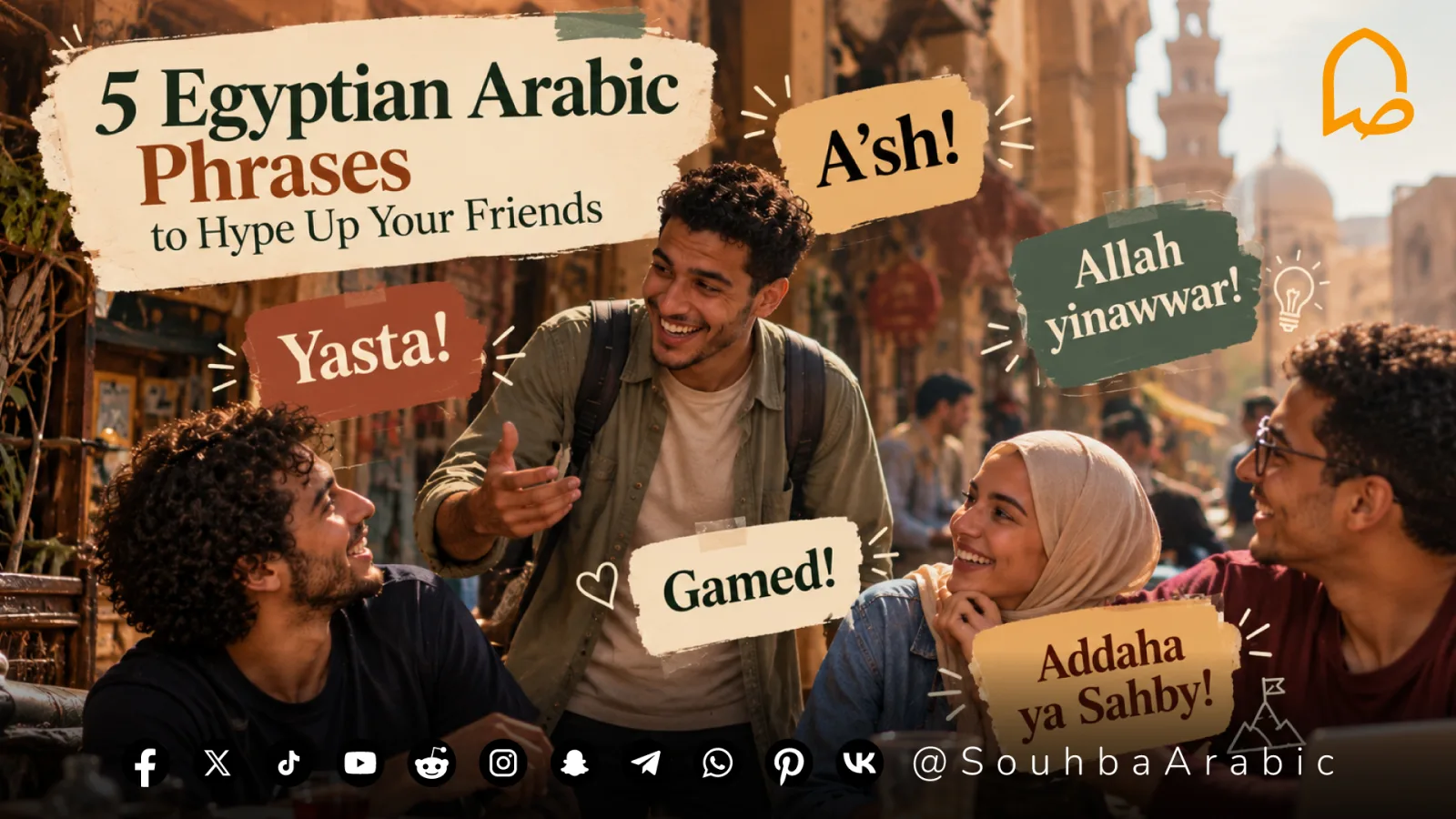
When your Egyptian friend wins a match, finishes a difficult task, or does something impressive, you probably want to say "Nice one!", "You're awesome!", or "You've got this!"
In Egyptian Arabic, there are short, expressive ways to do exactly that. These phrases are useful in casual conversations with friends, classmates, and teammates. They can also help you understand the language you encounter in Egyptian videos, comments, and messages.
Here are five expressions to start practising.
In This Guide
- عَاشْ! — Nice one!
- يَـسْـطَـى — Bro!
- اللَّه يِنَوَّرْ! — Brilliant!
- جَامِدْ! — Awesome!
- قَدَّهَا يَا صَاحْبِي! — You've got this!
1. عَاشْ! — "Nice one!" / "Well done!"
Pronunciation: A'sh!
Use عاش! to celebrate a win or praise someone for doing something well. It is short, enthusiastic, and easy to use in casual conversation.
Say it to a friend
عَاشْ يَا بَطَلْ!
A'sh ya Batal!
"Nice one, champ!"
Or add a familiar form of address:
عَاشْ يَـسْـطَـى!
A'sh Yasta!
"Nice one, bro!"
When to use it
- Your friend wins a football match
- Someone completes a difficult task
- Your friend shares some good news
Tip: You can use A'sh! on its own. You don't need to add anything else for the praise to make sense.
2. يَـسْـطَـى — "Bro!" / "Mate!"
Pronunciation: Yasta!
Yasta is a casual Egyptian way to address someone, especially in informal conversation between men. Depending on context, it can sound like "bro" or "mate."
You will often hear it alongside other expressions:
عَاشْ يَـسْـطَـى!
A'sh Yasta!
"Nice one, bro!"
When to use it
Use Yasta with friends or people you are on casual terms with. It is informal, so it is not the best choice for a formal meeting or a professional email.
A small cultural note: The Arabic word is traditionally associated with a skilled worker or master craftsman. In everyday Egyptian speech, it also functions as a familiar form of address.
3. اللَّه يِنَوَّرْ! — "Brilliant!" / "Well done!"
Pronunciation: Allah yinawwar!
This Egyptian expression is used to praise someone for doing something well, giving a good answer, or explaining something clearly.
A common extended version is:
اللَّهُ يِنَوَّرْ عَلِيكْ!
Allah yinawwar A'leek!
"Brilliant work!" / "Well done!"
Say it to a friend
Imagine your friend fixes a computer problem that you couldn't solve.
اللَّهُ يِنَوَّرْ عَلِيكْ يَا صَاحْبِي!
Allah yinawwar A'leek ya Sahby!
"Brilliant work, my friend!"
When to use it
- Your friend gives a clever answer
- Someone explains a difficult topic clearly
- A friend fixes something or completes a task skillfully
Tip: This expression is especially useful when praising someone's work or answer, rather than simply cheering during a game.
4. جَامِدْ! — "Awesome!" / "Cool!"
Pronunciation: Gamed!
In Egyptian slang, جامد can mean "awesome," "cool," or "impressive." The meaning depends on the situation.
You can use it to react to something impressive or to compliment someone directly.
Say it to a friend
جَامِدْ أَوِي!
Gamed awi!
"Really awesome!"
You can also react to something your friend shows you:
جَامِدْ أَوِي!
Gamed awi!
"That's so cool!"
When to use it
- Your friend comes up with a great idea
- Someone shows you an impressive skill
- You see a great video, design, or performance
Tip: Gamed can describe a person or a thing. Use the phrase that fits what you're reacting to.
5. قَدَّهَا يَا صَاحْبِي! — "You've got this, my friend!"
Pronunciation: Addaha ya Sahby!
Use قدها to encourage someone who is facing a challenge. It means that they are capable of handling it or are up to the task.
For a more complete expression, you can say:
إِنْتَ قَدَّهَا يَا صَاحْبِي!
Enta Addaha ya Sahby!
"You've got this, my friend!"
When speaking to a woman:
إِنْتِي قَدَّهَا يَا صَاحْبَتِي!
Enti Addaha ya Sahbety!
"You've got this, my friend!"
Say it in a real situation
Your friend is nervous before an exam or an important presentation.
مَا تِقْلَقْش، إِنْتَ قَدَّهَا يَا صَاحْبِي!
Mat'ala'ash, enta Addaha ya Sahby!
"Don't worry, my friend. You've got this!"
When to use it
- Your friend is preparing for an exam
- Someone is nervous about a job interview
- A friend is working toward a difficult goal
Tip: This phrase is about encouragement and confidence. It is not just a way to praise something that has already happened.
Quick Reference: Which Phrase Should You Use?
| Situation | Egyptian Arabic | Meaning |
|---|---|---|
| Your friend wins a game | عَاشْ! | Nice one! |
| You want to address a male friend casually | يَـسْـطَـى | Bro! / Mate! |
| Someone does a great job | اللَّهُ يِنَوَّرْ عَلِيكْ! | Brilliant work! |
| Your friend impresses you | جَامِدْ | That's awesome! |
| Your friend needs encouragement | إِنْتَ قَدَّهَا يَا صَاحْبِي! | You've got this, my friend! |
Practise with a Mini-Conversation
Ahmed:
خَلَّصْتْ الْمَشْرُوعْ!
Khalleṣt el-mashroo'!
"I finished the project!"
Omar:
عَاشْ يَـسْـطَـى!
A'sh Yasta!
"Nice one, bro!"
Ahmed:
أَخَدْت وَقْتْ طَوِيلْ، بَسْ خَلَّصْتُه!
Akhadt wa't taweel, bas khallaṣto!
"It took a long time, but I finished it!"
Omar:
اللَّهُ يِنَوَّرْ عَلِيكْ، جَامِدْ!
Allah yinawwar A'leek, gamed!
"Brilliant work! You're awesome!"
This is an illustrative practice dialogue, not a verbatim quotation from a recorded conversation.
One Final Tip
Learning a phrase is only the first step. To sound natural, pay attention to the situation, the relationship between speakers, and the way native speakers pronounce the words. Egyptian Arabic is informal and expressive, and the same phrase can feel different depending on tone.
At Souhba, you can practise Egyptian Arabic through real-life conversations instead of memorizing vocabulary lists alone.
Editorial Note
The Arabic phrases in this guide are presented as practical examples of colloquial Egyptian Arabic.
On transliteration: The English transliterations are simplified pronunciation guides. Spellings such as A'sh, Yasta, Gamed, and Sahby are informal learner conventions rather than a standardized transliteration system.
On tashkeel: Tashkeel in colloquial Arabic is not fully standardized, so the marked Arabic forms are intended to help learners approximate pronunciation.
Master the Arabic Language
Learn Egyptian Arabic, MSA, or Quran & Tajweed 1-on-1 with patient native tutors.
Free 30-minute trial · no card needed