Malesh in Egyptian Arabic: Meaning, Uses, and Examples
What does Malesh really mean in Egyptian Arabic? Learn five everyday uses, from “sorry” and “don't worry” to softening requests and polite corrections.

Muhammad
Oct 7, 2026 • 6 min read
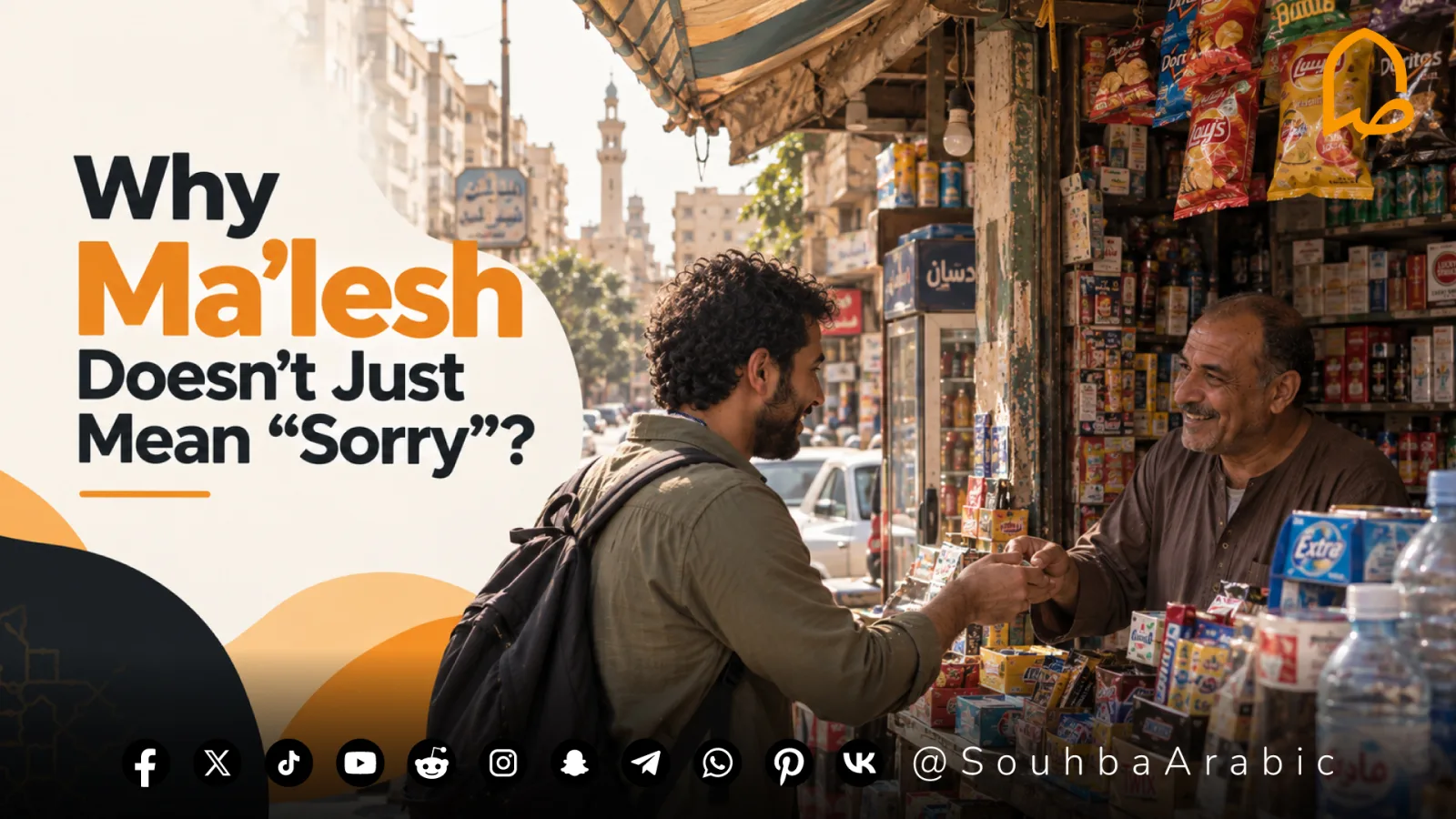
Why “Ma'lesh” Doesn't Just Mean “Sorry”: 5 Situations Egyptians Use It
If you look up the Egyptian Arabic expression مَعْلِش (maʿlesh), you may find translations such as “sorry,” “never mind,” “it’s okay,” or “no problem.”
The problem is that none of those translations tells you exactly when Egyptians use it.
At its core, مَعْلِش helps soften an uncomfortable moment. You can use it when you are apologizing, comforting someone, asking for something, accepting an apology, or even politely correcting someone.
So instead of memorizing one English translation, it is more useful to learn what Egyptians are doing with the expression in different situations.
Here are five everyday uses you are likely to hear.
1. When You Make a Small Mistake: “Sorry”
This is probably the first use you will notice.
If you bump into someone, arrive a little late, forget something small, or cause a minor inconvenience, مَعْلِش can work as a light, everyday apology.
| Arabic | Transliteration | English |
|---|---|---|
| مَعْلِش، اتْأَخَّرْت. | Maʿlesh, etʾakhkhart. | “Sorry, I’m late.” |
Or if you accidentally step on someone's foot:
| Arabic | English |
|---|---|
| مَعْلِش! | “Sorry!” |
You do not necessarily need a long apology for a small everyday mistake. A simple مَعْلِش can acknowledge what happened and keep the situation light.
2. When Someone Is Having a Hard Time: “Don’t Worry”
This is one of the meanings that can confuse English-speaking learners.
Imagine your friend studied for an exam but did not pass. Or someone tells you that something they hoped for did not work out.
You might say:
| Arabic | Transliteration | English |
|---|---|---|
| مَعْلِش، خَيْرْهَا فِي غَيْرْهَا. | Maʿlesh, kheirha fi gheirha. | “Don’t worry. There will be another chance.” |
Here, you are not apologizing.
You are acknowledging that something went wrong and trying to make the situation feel a little lighter. Depending on the context, مَعْلِش can feel like:
| Possible meaning | Nuance |
|---|---|
| “Don’t worry.” | Reassuring someone |
| “It’s okay.” | Accepting the situation |
| “That’s alright.” | Softening the moment |
| “Never mind.” | Letting it go |
The exact English translation depends on what happened and how the speaker says it.
3. Before a Request: “Excuse Me…”
You can also put مَعْلِش before a question or request to make it feel less abrupt.
You have not necessarily done anything wrong. You are simply acknowledging that you are interrupting someone or asking something of them.
| Arabic | Transliteration | English |
|---|---|---|
| مَعْلِش، مُمْكِن تِسَاعِدْنِي؟ | Maʿlesh, momken tesāʿedni? | “Excuse me, could you help me?” |
| مَعْلِش، مُمْكِن أَعَدِّي؟ | Maʿlesh, momken aʿaddi? | “Excuse me, can I get through?” |
| مَعْلِش، مُمْكِن تِقُولِّي السَّاعَة كَام؟ | Maʿlesh, momken teʾolli es-sāʿa kām? | “Excuse me, could you tell me what time it is?” |
For someone visiting Egypt, this is a particularly useful pattern to learn:
مَعْلِش + request
It makes a question sound more natural and less direct in many everyday situations.
4. When Someone Apologizes to You: “It’s Okay”
Here is another reason مَعْلِش can be confusing.
You can use it when you make a small mistake, but you can also use it when someone else makes one.
Imagine someone bumps into you:
| Speaker | Arabic | Transliteration | English |
|---|---|---|---|
| Person 1 | مَعْلِش، آسِف. | Maʿlesh, āsef. | “Sorry.” |
| Person 2 | مَعْلِش. | Maʿlesh. | “It’s okay.” |
You could also say:
| Arabic | Transliteration | English |
|---|---|---|
| مَفِيش مُشْكِلَة. | Mafīsh mushkela. | “There’s no problem.” |
The situation tells you which meaning is intended.
This is an important lesson when learning Egyptian Arabic: a word does not always have one fixed English equivalent. Sometimes you need to understand the social function of the expression rather than translate it word for word.
5. When You Need to Correct Someone: “No, Wait…”
You may also hear مَعْلِش when someone is correcting or disagreeing with another person.
For example:
| Speaker | Arabic | Transliteration | English |
|---|---|---|---|
| Person 1 | أَنْتَ كَلَّمْتَهُمْ أَمْبَارِح، صَحّ؟ | Anta kallamtuhum ambāriḥ, ṣaḥḥ? | “You called them yesterday, right?” |
| Person 2 | لَا، مَعْلِش، أَنَا كَلَّمْتُهُمْ أَمْبَارِح. | Lā, maʿlesh, ana kallamtuhum ambāriḥ. | “No, actually, I called them yesterday.” |
Here, مَعْلِش does not literally mean “actually.”
Instead, it helps soften the correction. The speaker is disagreeing, but not making the disagreement sound unnecessarily harsh.
You may hear this kind of usage when someone wants to say, in effect:
| Possible meaning | Nuance |
|---|---|
| “No, wait…” | Softening a correction |
| “Actually, no…” | Politely disagreeing |
| “Sorry, but…” | Easing into a correction |
| “No, that's not quite right.” | Gentle disagreement |
So don't memorize لَا، مَعْلِش as a fixed translation for “actually.” Listen to what is happening in the conversation.
When Should You Say “I'm Sorry”? — آسِف / آسِفَة
Because مَعْلِش is so common, beginners sometimes assume it is the only way to apologize.
It isn't.
When you want to give a direct apology or clearly express regret, you can use آسِف if you are male and آسِفَة if you are female.
| Speaker | Arabic | Transliteration | English |
|---|---|---|---|
| Male | أَنَا آسِف، غَلْطَتِي. | Ana āsef, ghalṭeti. | “I'm sorry. It was my mistake.” |
| Female | أَنَا آسِفَة، غَلْطَتِي. | Ana āsefa, ghalṭeti. | “I'm sorry. It was my mistake.” |
The difference is not simply “مَعْلِش = minor mistake” and “آسِف = serious mistake.”
Rather, مَعْلِش is a very flexible everyday expression that can soften a situation, while آسِف / آسِفَة makes the apology more explicit.
For a small everyday inconvenience, مَعْلِش may be all you need. When you want to clearly say that you are sorry and take responsibility, آسِف / آسِفَة is more direct.
A Quick Reference Guide
| Egyptian Arabic | What it can mean | The situation |
|---|---|---|
| مَعْلِش | Sorry | You caused a small inconvenience or made a minor mistake. |
| مَعْلِش | Don't worry / It's okay | You are comforting someone who is upset. |
| مَعْلِش | Excuse me... | You are interrupting someone to ask a question or request. |
| مَعْلِش | It's okay / No problem | Someone apologizes to you for a small mistake. |
| لَا، مَعْلِش | No, wait / Actually, no | You are politely correcting or disagreeing with someone. |
| أَنَا آسِف / آسِفَة | I'm sorry | You want to give a direct apology or express regret clearly. |
Tone Matters
Like many everyday expressions, مَعْلِش can feel different depending on the speaker's tone and the situation.
A gentle:
| Arabic | Transliteration | Feeling |
|---|---|---|
| مَعْلِش. | Maʿlesh. | “It's okay. Don't worry.” |
But a frustrated:
| Arabic | Transliteration | Feeling |
|---|---|---|
| مَعْلِش بَقَى! | Maʿlesh baʾa! | “Come on, enough already!” |
The words have not changed much. The tone, context, and situation have.
This is one reason Egyptian Arabic can be difficult to learn from vocabulary lists alone. You do not just need to know what a word means on paper; you need to understand what Egyptians do with it in real conversations.
The Best Way to Learn مَعْلِش
The next time you hear an Egyptian say مَعْلِش, don't immediately translate it in your head as “sorry.”
First ask yourself:
What just happened?
| Question | What to notice |
|---|---|
| Did someone make a small mistake? | → It may mean “sorry.” |
| Is someone trying to comfort another person? | → It may mean “don't worry.” |
| Are they about to ask for something? | → It may mean “excuse me.” |
| Are they accepting an apology? | → It may mean “it's okay.” |
| Are they correcting someone? | → It may mean “no, wait.” |
Once you understand the situation, the meaning of مَعْلِش usually becomes much clearer.
That is how expressions like this become useful in real Egyptian Arabic: not by memorizing five separate translations, but by learning the situations in which Egyptians naturally use them.
Learn Egyptian Arabic in Context
Expressions like مَعْلِش are much easier to understand when you hear them in real conversations.
At Souhba, we focus on the Arabic people actually use: natural pronunciation, everyday situations, and the cultural context behind the words. If you are learning Egyptian Arabic for travel, family, friendships, or everyday life, a personalized 1-to-1 lesson can help you move beyond memorizing phrases and start understanding how they work in conversation.
Start your Egyptian Arabic journey with Souhba.
Master the Arabic Language
Learn Egyptian Arabic, MSA, or Quran & Tajweed 1-on-1 with patient native tutors.
Free 30-minute trial · no card needed