How to Order at a Restaurant in Egyptian Arabic
Going to a restaurant in Egypt? Learn the Egyptian Arabic phrases you’ll actually use to get a table, order food and drinks, customize your meal, ask about ingredients, request the bill, pay, and handle common restaurant situations.
Nady
Sep 20, 2026 • 8 min read
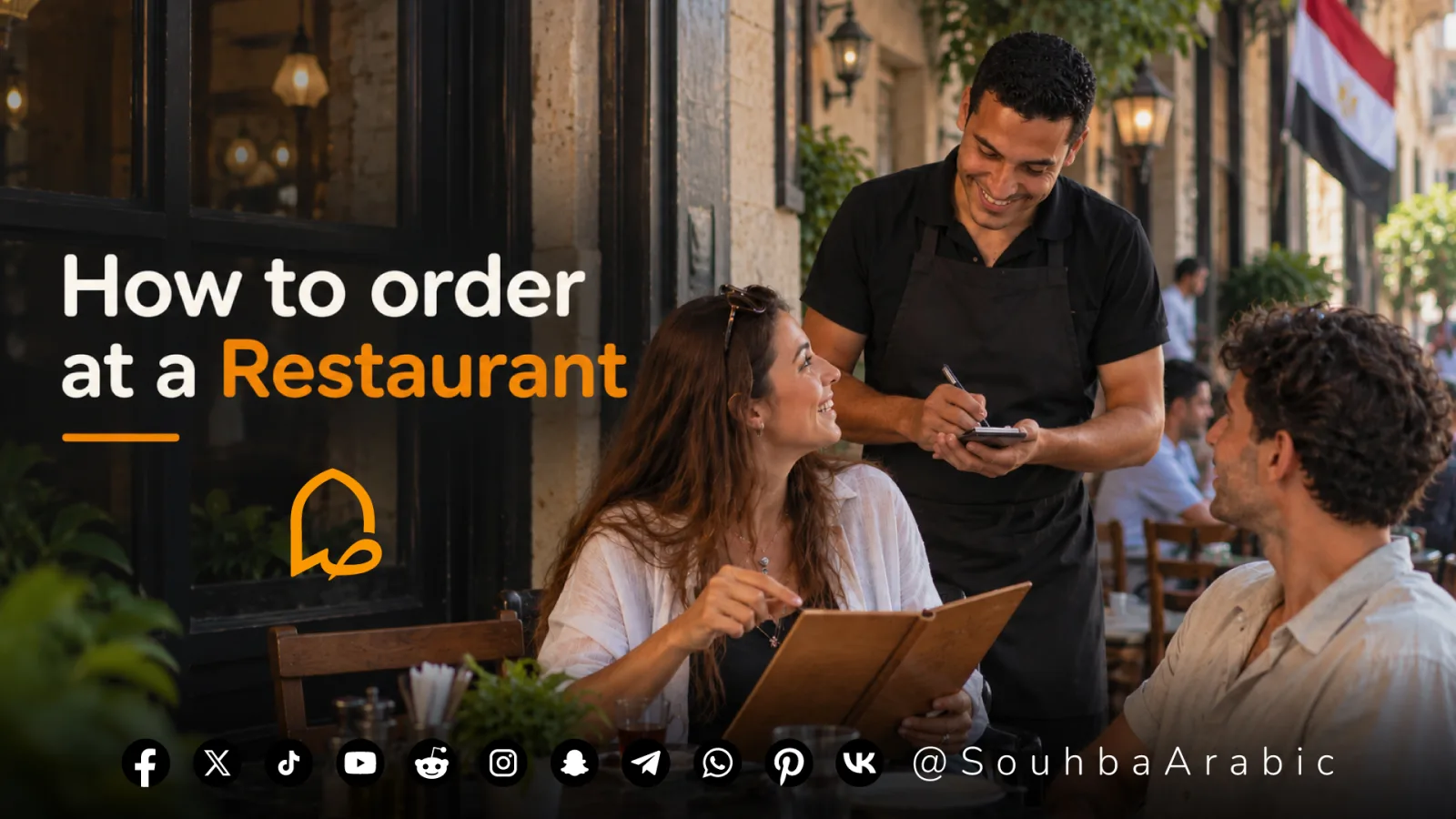
How to Order at a Restaurant in Egyptian Arabic
If you're traveling to Egypt, eating out is one of the easiest ways to practice Egyptian Arabic.
You don't need complicated sentences. In an Egyptian restaurant, most interactions are short and straightforward: “Can we sit here?” “The menu, please.” “What do you recommend?” “Without onions.” “Is this spicy?” “The bill, please.”
The useful part is knowing what to say and what the waiter might say back.
Here are the phrases you'll actually need.
1. Getting the waiter's attention
The easiest way to politely get someone's attention is:
لو سمحت
Law samaḥt
Excuse me / Please
When speaking to a woman:
لو سمحتي
Law samaḥti
You'll use لو سمحت constantly—in restaurants, cafés, shops, taxis, and everyday situations.
You can simply say:
لو سمحت!
Then make your request.
For example:
لو سمحت، المنيو.
“The menu, please.”
Or more naturally:
ممكن المنيو لو سمحت؟
“Can I have the menu, please?”
2. Asking for a table
If you walk into a restaurant, you might need to ask whether they have a table.
عندكم ترابيزة لشخصين؟
ʿAndoku(m) tarabēza le-shakhṣēn?
Do you have a table for two?
In everyday Egyptian Arabic, ترابيزة (tarabēza) is very common for “table.”
If you already have a reservation:
عندي حجز.
ʿAndi ḥagz.
I have a reservation.
The staff might say:
اتفضل.
Etfaḍḍal.
Please / Go ahead / Here you are.
For a woman, اتفضلي (etfaḍḍali).
3. Asking for the menu
The most useful version is:
ممكن المنيو لو سمحت؟
Mumken el-menu law samaḥt?
Can I have the menu, please?
You'll often hear المنيو (el-menu) in everyday Egyptian speech rather than the formal قائمة الطعام.
If there are several of you:
ممكن منيوهات لو سمحت؟
Mumken menu-hāt law samaḥt?
Can we have some menus, please?
4. Asking what they recommend
Don't know what to order?
Ask:
إيه أحسن حاجة عندكم؟
Eh aḥsan ḥāga ʿandoku(m)?
What's the best thing you have?
Or:
إيه اللي تنصحني بيه؟
Eh elli tenṣaḥni bēh?
What do you recommend?
This is often more useful than trying to understand every item on the menu.
You can also ask about a specific dish:
ده إيه؟
Da eh?
What's this?
ده بيتعمل بإيه؟
Da beyitʿamel bēh?
What is this made with?
5. Ordering your food
For a male speaker:
أنا عايز...
Ana ʿāyez...
I'd like / I want...
For a female speaker:
أنا عايزة...
Ana ʿāyza...
For example:
أنا عايز شاورما لحمة، لو سمحت.
Ana ʿāyez shawerma laḥma, law samaḥt.
I'd like a beef shawarma, please.
But you don't always need أنا عايز.
It's perfectly natural to simply say:
واحد شاورما لحمة، لو سمحت.
Wāḥed shawerma laḥma, law samaḥt.
One beef shawarma, please.
Or:
ممكن شاورما لحمة؟
Mumken shawerma laḥma?
Can I have a beef shawarma?
For a group:
عايزين...
ʿĀyzīn...
We'd like...
6. Ordering drinks
Some very useful phrases:
ممكن مية لو سمحت؟
Mumken mayya law samaḥt?
Can I have some water, please?
إزازة مية لو سمحت.
Izāzet mayya law samaḥt.
A bottle of water, please.
ممكن شاي؟
Mumken shāy?
Can I have tea?
ممكن قهوة؟
Mumken ahwa?
Can I have coffee?
If you don't want ice:
من غير تلج لو سمحت.
Men gheir talg law samaḥt.
Without ice, please.
7. Changing something in your order
This is one of the most useful things to know.
“Without...”
من غير...
Men gheir...
Without...
Examples:
من غير بصل لو سمحت.
Men gheir baṣal law samaḥt.
Without onions, please.
من غير شطة لو سمحت.
Men gheir shaṭṭa law samaḥt.
Without chili/hot sauce, please.
من غير سكر.
Men gheir sokkar.
Without sugar.
“On the side”
If you want something separate:
على جنب لو سمحت.
ʿAla gamb law samaḥt.
On the side, please.
For example:
الصوص على جنب لو سمحت.
“The sauce on the side, please.”
“Extra”
زيادة لو سمحت.
Zeyāda law samaḥt.
Extra, please.
For example:
جبنة زيادة لو سمحت.
“Extra cheese, please.”
8. If you don't eat something
For a simple preference:
أنا مش باكل لحمة.
Ana mish bākul laḥma.
I don't eat meat.
أنا نباتي.
Ana nabāti.
I'm vegetarian.
For a woman:
أنا نباتية.
Ana nabātiyya.
But if you have an allergy, don't rely only on من غير....
Say clearly:
عندي حساسية من...
ʿAndi ḥasāsiyya men...
I'm allergic to...
For example:
عندي حساسية من المكسرات.
ʿAndi ḥasāsiyya men el-mokassarāt.
I'm allergic to nuts.
Then make sure the staff understands exactly what you mean. For a serious allergy, it's worth confirming that the food does not contain the ingredient and asking about cross-contact rather than assuming “without” guarantees safety.
9. Asking if something is spicy
This is essential if you're not used to Egyptian food.
الأكل ده حراق؟
El-akl da ḥarāʾ?
Is this food spicy?
You can also ask:
ده حار أوي؟
Da ḥār awi?
Is this very spicy?
If you want it mild:
ممكن من غير شطة؟
Mumken men gheir shaṭṭa?
Can I have it without chili/hot sauce?
10. Asking what something is
If the menu has a dish you don't recognize:
ده عبارة عن إيه؟
Da ʿibāra ʿan eh?
What is this? / What does this consist of?
Or simply:
ده إيه؟
Da eh?
What's this?
And if you want to know what's inside:
فيه إيه؟
Fīh eh?
What's in it?
These three questions are much more useful than memorizing dozens of food names before your trip.
11. Understanding the waiter's replies
You should also recognize a few common replies.
حاضر.
Ḥāḍer.
Sure / Right away.
تمام.
Tamām.
Okay / All right.
اتفضل.
Etfaḍḍal.
Here you go / Please.
ثواني.
Sawāni.
Just a second.
لحظة.
Laḥẓa.
One moment.
You may also hear:
تحب تطلب إيه؟
Teḥebb teṭlob eh?
What would you like to order?
And for a group:
تحبوا تطلبوا إيه؟
Teḥebbu teṭlobu eh?
What would you like to order?
If the waiter asks:
تحب تشرب إيه؟
they're simply asking:
“What would you like to drink?”
12. Asking for something you forgot
Maybe you need another spoon, napkin, water, or sauce.
Use:
ممكن معلقة لو سمحت؟
Mumken maʿʾala law samaḥt?
Can I have a spoon, please?
ممكن شوكة؟
Mumken shōka?
Can I have a fork?
ممكن مناديل؟
Mumken manādīl?
Can I have some napkins?
ممكن مية كمان؟
Mumken mayya kamān?
Can I have some more water?
كمان means more / another one / also, and you'll hear it constantly in restaurants.
13. Asking where the restroom is
One phrase worth memorizing:
الحمام فين لو سمحت؟
El-ḥammām fēn law samaḥt?
Where's the restroom, please?
That's all you need.
14. If something is missing from your order
Suppose your food arrived, but you didn't get the salad or drink you ordered.
You can say:
معلش، السلطة ماجتش.
Maʿlesh, es-salaṭa magetsh.
Excuse me, the salad didn't come.
Or:
معلش، أنا طلبت كذا.
Maʿlesh, ana ṭalabt kaza.
Excuse me, I ordered this.
Then point to the item or menu.
You don't need a long explanation.
15. When you're finished
If the food was good, a simple:
الأكل حلو أوي، شكرًا.
El-akl ḥelw awi, shokran.
The food was really good, thank you.
works perfectly.
You may also hear the traditional expression:
بالهنا والشفا.
Bel-hana wish-shifa.
It is a common Egyptian expression associated with enjoying food, roughly wishing someone enjoyment and well-being from the meal.
You can simply smile and say:
شكرًا.
16. Asking for the bill
The classic phrase:
الحساب لو سمحت.
El-ḥesāb law samaḥt.
The bill, please.
Or:
ممكن الحساب لو سمحت؟
Mumken el-ḥesāb law samaḥt?
Can I have the bill, please?
You'll hear الحساب much more naturally in this situation than trying to construct a formal sentence about paying the “invoice.”
17. Paying by card or cash
If you want to pay by card:
ممكن أدفع بالكارت؟
Mumken adfaʿ bel-kārt?
Can I pay by card?
You can also simply ask:
بتقبلوا كارت؟
Betʾabalu kārt?
Do you accept cards?
If you're asking whether they accept cash, you can ask:
كاش؟
Kāsh?
In many places, especially smaller restaurants and street-food spots, it's useful to ask about payment before ordering if you don't have another option.
18. What about the tip?
If you want to leave the change:
خلي الباقي.
Khalli el-bāʾi.
Keep the change.
If you want to ask about the service charge:
الخدمة موجودة؟
El-khedma mawgooda?
Is service included?
And if you're unsure whether a tip is expected, simply ask:
البقشيش كام؟
El-baʾshīsh kām?
How much should the tip be?
Tip practices can vary by restaurant, so don't assume that every place handles it the same way.
A complete restaurant conversation
Here is what a normal interaction might sound like:
You:
لو سمحت، ممكن المنيو؟
“Excuse me, can I have the menu?”
Waiter:
اتفضل.
“Here you go.”
You:
إيه أحسن حاجة عندكم؟
“What do you recommend?”
Waiter:
الكشري حلو أوي.
“The koshary is really good.”
You:
تمام. واحد كشري، لو سمحت. ومن غير شطة.
“Okay. One koshary, please. And without chili.”
Waiter:
تحب تشرب إيه؟
“What would you like to drink?”
You:
إزازة مية، لو سمحت.
“A bottle of water, please.”
Later:
You:
الحساب لو سمحت.
“The bill, please.”
Waiter:
حاضر.
“Sure.”
That's enough Arabic to get through a large part of a normal restaurant visit.
The restaurant phrases worth memorizing
You don't need a 100-word restaurant vocabulary list before visiting Egypt.
Start with these:
لو سمحت — Excuse me / Please
ممكن المنيو؟ — Can I have the menu?
إيه أحسن حاجة عندكم؟ — What do you recommend?
عندكم...؟ — Do you have...?
أنا عايز / عايزة... — I'd like...
من غير... — Without...
على جنب — On the side
زيادة — Extra
ده حراق؟ — Is this spicy?
فيه إيه؟ — What's in it?
عندي حساسية من... — I'm allergic to...
الحمام فين؟ — Where's the restroom?
ممكن الحساب؟ — Can I have the bill?
ممكن أدفع بالكارت؟ — Can I pay by card?
خلي الباقي — Keep the change
شكرًا — Thank you
The important thing isn't to memorize them as isolated vocabulary.
Practice them as little pieces of conversation. In a real Egyptian restaurant, you'll usually need only a few words at a time.
That's what makes Egyptian Arabic practical: you don't need perfect sentences to communicate. You need the right phrases, used naturally, at the right moment.
Master the Arabic Language
Learn Egyptian Arabic, MSA, or Quran & Tajweed 1-on-1 with patient native tutors.
Free 30-minute trial · no card needed