The War That Began With a Camel: Al-Basus and the Cost of Revenge
A dispute over a wounded camel became one of the most famous feuds in Arab history. Discover the story of the War of Al-Basus, the rivalry between Bakr and Taghlib, and the legendary figure of Al-Muhalhil.

Ahmed
Nov 17, 2026 • 7 min read
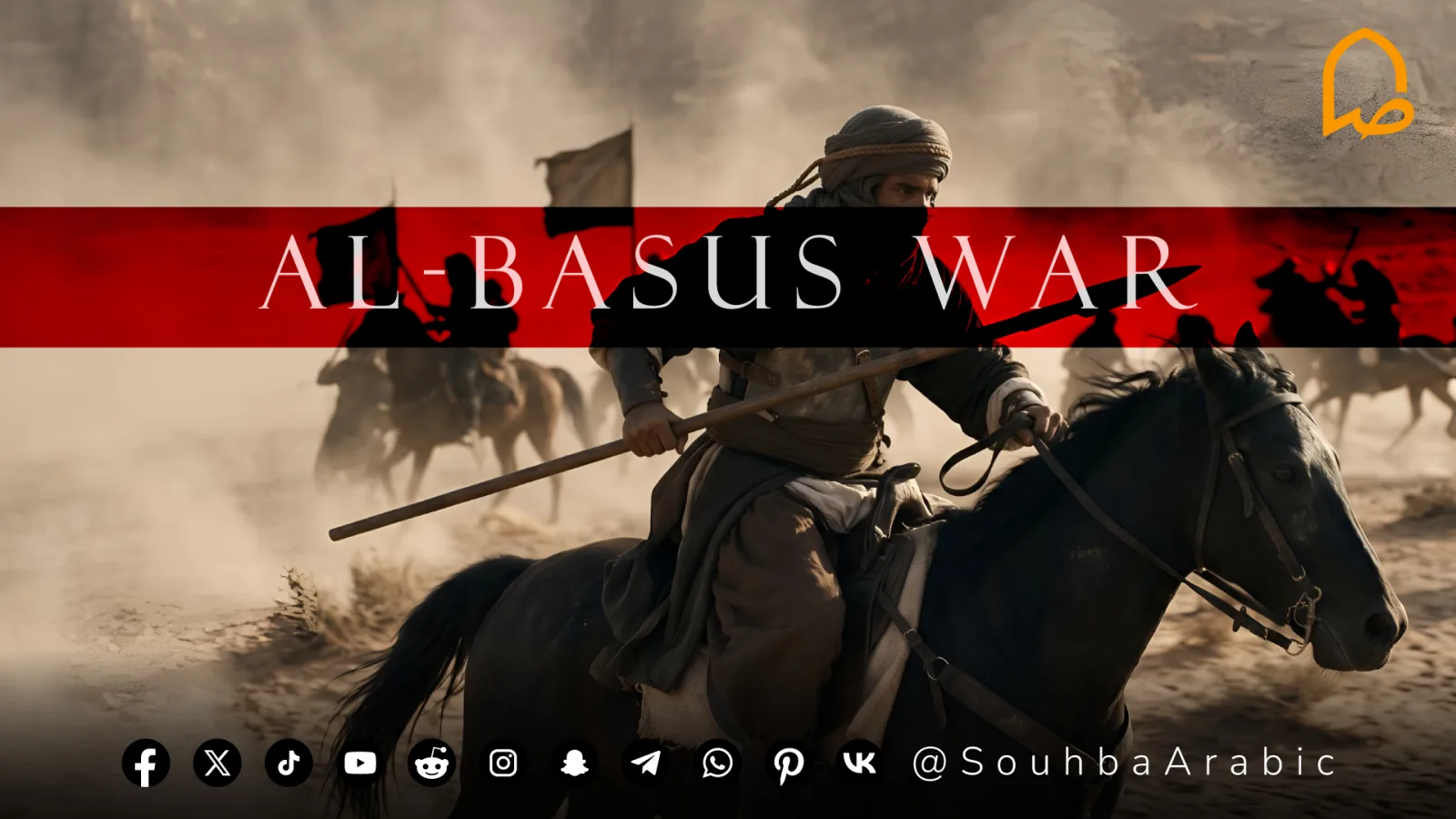
The War of Al-Basus (حَرْب البَسُوس): The Story Behind One of Arabia’s Most Famous Feuds
Long before Islam, in the vast landscapes of the Arabian Peninsula, two powerful tribes became caught in a conflict that would live in Arab memory for centuries.
It began with a camel.
The animal belonged to a man staying under the protection of a woman named Al-Basus. When it wandered into land controlled by a powerful tribal chief, an act of violence turned a seemingly small dispute into a cycle of revenge. Men were killed, alliances were tested, and two related tribes found themselves drawn into a feud that traditional accounts say lasted forty years.
This became known as حَرْب البَسُوس (Ḥarb al-Basūs) — the War of Al-Basus.
But the story is about much more than an animal or a quarrel. It offers a glimpse into the tribal world of pre-Islamic Arabia, where honour, protection, loyalty, and revenge could shape the fate of entire communities.
At a Glance
| Name | حَرْب البَسُوس (Ḥarb al-Basūs) — The War of Al-Basus |
| Era | Pre-Islamic Arabia |
| Main Tribes | Bakr and Taghlib (both branches of Rabīʿah) |
| Trigger | A she-camel named Sarāb strayed into protected land |
| Key Figures | Al-Basus bint Munqidh, Kulayb ibn Rabīʿah, Jassās ibn Murrah, Al-Muhalhil (Al-Zīr Sālim) |
| Traditional Duration | Forty years |
| Historical Status | Preserved in Ayyām al-ʿArab accounts, poetry, and later popular literature |
A Camel Crosses Into Forbidden Land
The story takes place in the world of two closely related tribes: Bakr and Taghlib, both branches of the larger Rabīʿah tribal group.
The Key Figures
| Figure | Tribe | Role |
|---|---|---|
| Al-Basus bint Munqidh | — | The woman whose name became linked to the war |
| Jassās ibn Murrah | Bakr | Her nephew; host to the guest |
| Saʿd ibn Shams al-Jarmī | — | The guest under Al-Basus’s protection; owner of the she-camel |
| Kulayb ibn Rabīʿah | Taghlib | Powerful chief who controlled the protected pasture |
| Al-Muhalhil ibn Rabīʿah | Taghlib | Kulayb’s brother; known as Al-Zīr Sālim |
Among the most powerful figures of that time was Kulayb ibn Rabīʿah, a chief of Taghlib. Traditional accounts describe him as a man of considerable authority who controlled a protected grazing area known as a ḥimā. Entry into this land, particularly with livestock, required his permission.
One day, a woman named Al-Basus bint Munqidh was staying with her nephew, Jassās ibn Murrah, from the Bakr tribe. A guest under her protection, Saʿd ibn Shams al-Jarmī, owned a she-camel named Sarāb.
What Happened
| Step | Event |
|---|---|
| 1 | The camel wandered into Kulayb’s protected pasture. |
| 2 | Kulayb shot it with an arrow. |
| 3 | Al-Basus was outraged and called upon her nephew to defend the honour of those under his protection. |
| 4 | Jassās confronted Kulayb and killed him. |
| 5 | A single killing had now created a demand for another. |
What might seem to a modern reader like a dispute over livestock carried a much deeper meaning in that society. Protection was a serious responsibility. A person who offered someone shelter was expected to defend that person’s safety and standing. To harm someone under another’s protection could be understood as an insult reaching far beyond the immediate victim.
Al-Basus was outraged. In the traditional telling, she raised her voice in protest and called upon her nephew to defend the honour of those under his protection.
Her words and the humiliation surrounding the incident helped ignite what followed.
The Brother Who Would Not Let the Killing Go Unanswered
Kulayb’s death changed the course of the conflict.
His brother, Al-Muhalhil ibn Rabīʿah, became determined to avenge him. In the stories passed down through Arab literary and popular tradition, Al-Muhalhil is remembered as both a poet and a central figure in the struggle between the two tribes.
He is also widely known by another name: Al-Zīr Sālim.
Note: The name Al-Zīr Sālim became especially familiar through later popular storytelling, including the famous Syrian television series Al-Zīr Sālim. The stories portray a man whose earlier life was transformed by the death of his brother, turning him into a relentless seeker of revenge.
For Al-Muhalhil, the matter was no longer simply about a camel or a pasture. It was about his brother’s blood, his family’s honour, and the obligation to answer a killing.
But revenge rarely ends where it begins.
As the conflict continued, attacks and counterattacks deepened the hostility between Bakr and Taghlib. Each new loss created another reason to fight. Attempts at reconciliation struggled against the weight of earlier bloodshed and the expectations placed upon tribal leaders.
The original dispute had become something much larger than the people who first took part in it.
Forty Years of War — History and Legend
The War of Al-Basus is traditionally said to have lasted forty years.
That number has become inseparable from the story. It appears repeatedly in popular accounts and has helped establish the conflict as one of the most enduring examples of a feud that seemed impossible to end.
The Historical Record
| Aspect | Detail |
|---|---|
| How it was remembered | In the tradition of Ayyām al-ʿArab — accounts of important battles and conflicts among the Arabs before Islam |
| How the story developed | Over centuries through historical writing, poetry, oral storytelling, and later popular literature |
| Key academic study (2025) | Ali Ahmad Hussein, Journal of Islamic Studies — examines the war’s place in classical Arabic poetry |
| Important distinction | The conflict’s presence in early poetry was more limited than its enormous reputation in later Arab literature and popular memory |
Important: This does not make the story unimportant. It reminds us that historical events and the stories societies build around them are not always the same thing.
The exact duration of the conflict and many details of its familiar narrative cannot be independently established with certainty.
A Story That Outlived the People Who Fought It
The War of Al-Basus survived far beyond the tribes and generations involved in it.
Its story was carried through historical chronicles, poetry, and oral traditions. Over time, Al-Muhalhil became a memorable figure in the Arab imagination: the poet whose grief and desire for revenge became inseparable from the story of his brother’s death.
The Proverb
The conflict also left its mark on Arabic proverbial tradition. One expression associated with Al-Basus is:
أَشْأَمُ مِنَ الْبَسُوسِ
Often translated as “more ill-omened than Al-Basus,” the proverb appears in classical Arabic proverb collections and dictionaries. It reflects the association between her name and a chain of misfortune that followed the original incident.
In Popular Culture
The story has continued to find new audiences, particularly through television and popular retellings. For many viewers, the name Al-Zīr Sālim brings to mind a world of desert journeys, tribal rivalries, poetry, loyalty, and revenge.
The Tragedy Behind the Legend
It is tempting to remember the War of Al-Basus simply as a story about a camel that started a forty-year war. But that description misses what made the story endure.
It is a story about:
| Theme | What It Shows |
|---|---|
| Honour | How honour can become entangled with pride |
| Loyalty | How loyalty can turn into an obligation for revenge |
| Consequence | How one act of violence can create consequences that outlive everyone directly involved |
The traditional account may have grown and changed over the centuries, but its central tragedy remains clear:
Once revenge becomes the answer to every loss, peace becomes increasingly difficult to reach.
Perhaps that is why the War of Al-Basus still holds a place in Arab cultural memory. It is not remembered merely because it was long or violent, but because it represents the terrible cost of a conflict that no one seemed able to bring to an end.
Sources and Further Reading
| Source | Description |
|---|---|
| Ali Ahmad Hussein, “An Ancient Arabian War (Ḥarb al-Basūs) as Reflected in Classical Arabic Poetry,” Journal of Islamic Studies (2025) | An academic study of the war’s place in early Arabic poetry and its later literary development |
| Ibn al-Athīr, Al-Kāmil fī al-Tārīkh | A classical historical account preserving traditional narratives about the conflict |
| Al Jazeera Documentary, “Al-Basūs: The 40-Year War in the Arabian Peninsula” | An introduction to the story as remembered in popular Arab heritage |
Master the Arabic Language
Learn Egyptian Arabic, MSA, or Quran & Tajweed 1-on-1 with patient native tutors.
Free 30-minute trial · no card needed