What Is Egyptian Arabic? A Beginner’s Guide
Egyptian Arabic is the everyday spoken Arabic of Egypt. Learn what makes it different from Modern Standard Arabic, what it sounds like, who uses it, and where beginners should start.
Nady
Sep 8, 2026 • 8 min read
If you’re learning Arabic because you want to speak with people in Egypt, you’ll quickly come across a question:
What exactly is Egyptian Arabic?
Egyptian Arabic is the variety of Arabic commonly used in everyday conversation in Egypt. It is what you are likely to hear when people talk with friends, family, colleagues, shopkeepers, taxi drivers, and each other in daily life.
It is related to Modern Standard Arabic (MSA), but it is not simply MSA spoken with an Egyptian accent. Egyptian Arabic has its own vocabulary, pronunciation, expressions, and grammatical patterns.
For a beginner, understanding this difference can make the decision about what to study much easier.
What is Egyptian Arabic?
Egyptian Arabic is a spoken variety of Arabic used in Egypt. When people talk about “Egyptian Arabic,” they are often referring especially to the speech associated with Cairo and the surrounding region, although Arabic varieties across Egypt are not completely identical.
In everyday Egyptian life, you will hear Egyptian Arabic in conversations, shops, cafés, workplaces, homes, television, films, and many other informal settings.
You may also hear MSA or more formal Arabic mixed into speech, particularly in formal, educational, religious, or media-related contexts.
So Egyptian Arabic is best understood as part of the wider Arabic language landscape, not as a completely separate language.
Where is Egyptian Arabic spoken?
Egyptian Arabic is spoken throughout Egypt, although there are regional differences in how people speak.
Cairene Arabic, the variety associated with Cairo, has received particular attention in linguistic research and is often what learners mean when they say they want to learn Egyptian Arabic.
You may notice differences between speakers from Cairo, Alexandria, Upper Egypt, the Delta, Sinai, and other parts of the country.
These differences do not mean that there is one completely different language in every part of Egypt. Rather, Egyptian Arabic contains regional varieties and accents, just as many other widely spoken languages do.
For someone learning Arabic for life in Cairo or everyday communication in Egypt, learning commonly used Egyptian Arabic is a practical starting point.
Egyptian Arabic vs Modern Standard Arabic
This is one of the most important distinctions for Arabic learners.
Modern Standard Arabic, or MSA, is the formal variety used widely in writing and in formal contexts. You will encounter it in news, books, education, official communication, and other situations where formal Arabic is expected.
Egyptian Arabic is much more associated with everyday spoken interaction in Egypt.
A simple way to think about it is:
| Modern Standard Arabic | Egyptian Arabic |
|---|---|
| Formal writing | Everyday conversation |
| News and formal media | Casual conversations |
| Books and education | Daily life in Egypt |
| Formal contexts | Friends, family, shops, cafés |
| Broader formal Arabic | Egyptian everyday speech |
The distinction is useful, but real communication is not always divided into two completely separate boxes.
Egyptian speakers can move between different levels of Arabic depending on the situation, and educated speakers commonly have familiarity with MSA as well.
So if you hear an Egyptian speaker use a more formal expression, that does not necessarily mean they have suddenly stopped speaking Egyptian Arabic.
What does Egyptian Arabic sound like?
Egyptian Arabic has a sound that many learners quickly begin to associate with Egypt.
One feature that learners often notice in Cairene Arabic is the pronunciation of certain consonants.
For example, the letter ج is commonly pronounced as a hard “g” sound in Cairene Arabic. So a word containing ج may sound different from how a learner first encountered it in a formal Arabic setting.
The letter ق can also be pronounced differently in Cairene speech, often as a glottal stop in everyday Cairo pronunciation.
These are useful features to notice, but pronunciation is not the whole story.
Egyptian Arabic also has its own rhythm, vocabulary, expressions, and grammatical patterns.
This is why simply learning MSA vocabulary and trying to pronounce it with an Egyptian accent does not always produce natural Egyptian Arabic.
A simple example: يلا
One of the first Egyptian expressions many learners encounter is:
يلا — yalla
You may first learn it as “let’s go.”
But in real conversation, يلا can do more than that.
Depending on the situation and tone, it can communicate ideas such as:
- Let’s go.
- Come on.
- Hurry up.
- Okay.
- Alright, let’s do it.
The important lesson is not just the word itself.
It is learning how people actually use the word.
That is one reason context matters so much when learning Egyptian Arabic.
You can read a translation in a dictionary, but hearing an expression in real conversations teaches you something the translation alone cannot.
Why do people choose to learn Egyptian Arabic?
People learn Egyptian Arabic for many different reasons.
Some want to:
- Live in Egypt
- Travel around Egypt
- Speak with Egyptian friends
- Communicate with family
- Understand Egyptian films and television
- Feel more comfortable in everyday conversations
- Work with people in Egypt
- Build a connection with Egyptian culture
For these goals, learning the spoken language can be much more useful than focusing only on formal Arabic.
If your main goal is to have conversations with Egyptians, you want to learn the Arabic people actually use in those conversations.
That does not make MSA unimportant.
It simply means your learning path should match your goal.
Is Egyptian Arabic useful outside Egypt?
Yes, but it depends on what you mean by “useful.”
Egypt has a large population and a major cultural and media presence in the Arabic-speaking world. Egyptian films, television, music, and other forms of popular culture have helped make Egyptian Arabic familiar to many Arabic speakers outside Egypt.
If you travel elsewhere in the Arab world, you will encounter other spoken varieties of Arabic, and people may use different vocabulary or pronunciation.
You should not expect Egyptian Arabic to sound exactly the same as every other Arabic dialect.
At the same time, learning Egyptian Arabic gives you experience with real spoken Arabic and can help you become more comfortable listening to and interacting with Arabic speakers.
If your long-term goal is broader Arabic proficiency, you can also build on Egyptian Arabic by studying MSA or another variety later.
Should beginners learn Egyptian Arabic or MSA first?
There is no single answer.
Start with Egyptian Arabic if your main goal is:
- Speaking with Egyptians
- Living in Egypt
- Travelling in Egypt
- Everyday conversation
- Understanding Egyptian media and culture
MSA may make more sense as a starting point if your main goals are:
- Formal Arabic
- Reading
- News
- Education
- Writing
- Broader formal Arabic literacy
And you do not have to choose only one forever.
Many learners eventually develop knowledge of both spoken and formal Arabic.
The important thing is to begin with the variety that gives you the most useful connection to your actual goals.
Where should a beginner start with Egyptian Arabic?
You do not need to learn hundreds of words before having your first conversation.
A better starting point is to build a small foundation that you can actually use.
1. Learn the Arabic script
If you cannot read Arabic yet, start becoming comfortable with the letters and basic pronunciation.
You do not need perfect reading ability before beginning spoken Egyptian Arabic, but learning the script will become increasingly useful as you progress.
2. Learn useful everyday expressions
Start with expressions you are likely to hear and use.
For example:
- إزيك؟ — How are you?
- تمام — Fine / good / okay.
- ماشي — Okay / alright.
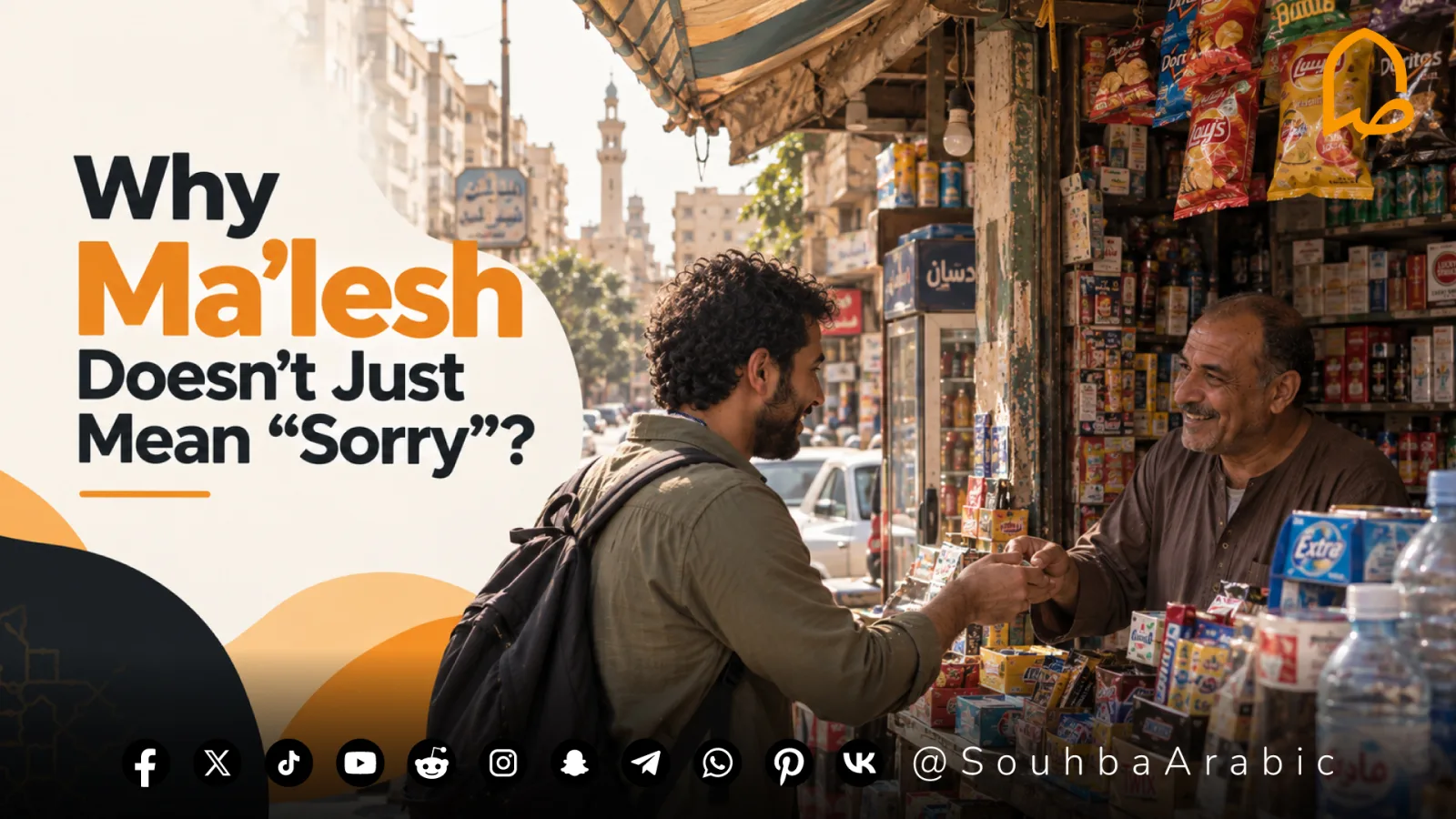
- معلش — Sorry / excuse me / never mind, depending on context.
- يلا — Come on / let's go / alright, depending on context.
The goal is not to memorize a long list.
The goal is to understand how these expressions work in real situations.
3. Listen before worrying about speaking perfectly
Egyptian Arabic can sound very different from the Arabic you may see in a textbook.
Listen to natural conversations, short videos, interviews, films, or lessons where people actually speak Egyptian Arabic.
Pay attention to rhythm and pronunciation, not only individual words.
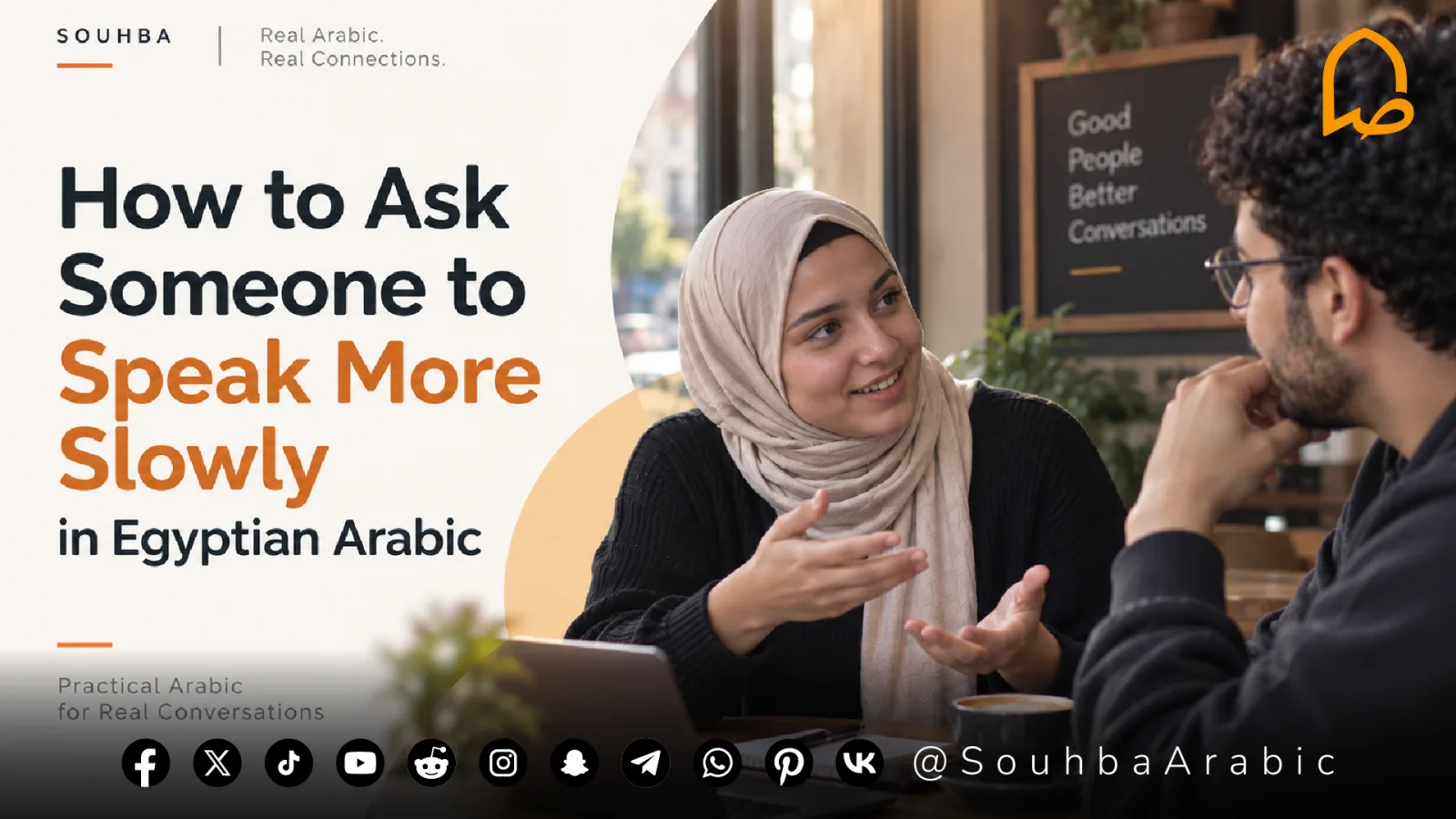
4. Practice with a person
This is where things begin to come together.
A teacher or conversation partner can help you understand whether something sounds natural, when an expression is appropriate, and how Egyptians might actually respond.
You can memorize a phrase on your own.
But using it naturally requires practice.
5. Learn around situations
Instead of studying disconnected vocabulary, build your Arabic around situations you expect to encounter.
For example:
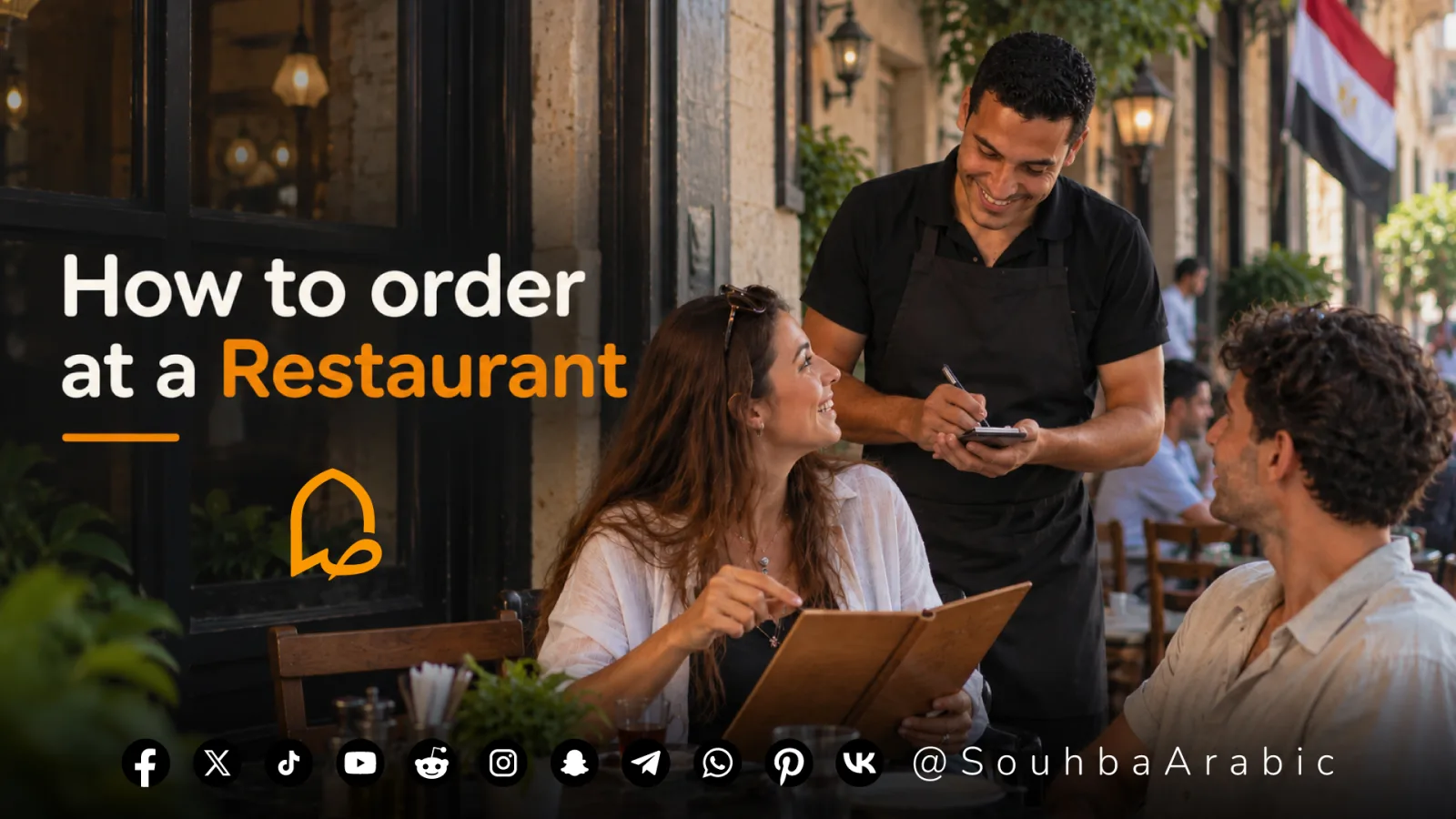
At a café
- What would you order?
- How would you ask for the bill?
- How would you respond to the waiter?
In a taxi
- How would you tell the driver where you are going?
- How would you ask how much the ride costs?
Meeting someone
- How would you introduce yourself?
- How would you ask where they are from?
This makes vocabulary easier to remember because every word has somewhere to go.
The most important thing to remember
Egyptian Arabic is not just a list of Egyptian words.
It is a living spoken variety used by people in real situations.
That means learning Egyptian Arabic is not only about knowing what a word means.
It is also about knowing when to use it, who to use it with, how it sounds, and what another person means when they say it to you.
If your goal is to speak with people in Egypt, start there.
Learn the language you actually want to use, practice it in context, and gradually build from everyday conversations toward greater fluency.
And if your goals change later, your Arabic can grow with them.
Ready to start learning Egyptian Arabic?
If you want to learn Egyptian Arabic for conversation, travel, life in Egypt, or another personal goal, your learning path should start with what you actually want to do with the language.
Master the Arabic Language
Learn Egyptian Arabic, MSA, or Quran & Tajweed 1-on-1 with patient native tutors.
Free 30-minute trial · no card needed